🧭 Introduction to Taiga
Taiga is an open-source project management tool with an intuitive interface and comprehensive support for Agile methodologies, including Scrum and Kanban.
Overview
Taiga helps project managers organize, track, and prioritize work using Agile methodologies, including Scrum and Kanban frameworks. As a powerful alternative to Jira or Trello, Taiga helps teams define deliverables, align priorities, and maintain transparency across ongoing activities and resource allocation.
Using Taiga, you can easily manage daily standups with your team. Create user stories that capture all required tasks, and include attachments, story points, internal requirements, client requests, and dependencies. Generate individual or bulk tasks and drag them into clear status swim lanes on the Sprint Taskboard. Story points, due dates, and blocked tasks are prominently displayed, making it simple to track high-priority items and assist team members facing blockers.
As Taiga offers robust customization options, you can easily configure and customize epics, user stories, tasks, issue workflows, custom fields, role permissions, integrations, and plugins. Create a project wiki for documentation and other content. To encourage team collaboration and engagement, highlight team member skills and contributions on the unique team board, such as highlighting a Bug Hunter for issue reporting. In addition, use Taiga’s powerful search capabilities to find any type of data across your project.
Taiga overview
Taiga deployment options
When choosing the best deployment option, consider your team’s size, familiarity with Linux and Docker, and the required level of technical support.
There are two main types of deployment options:
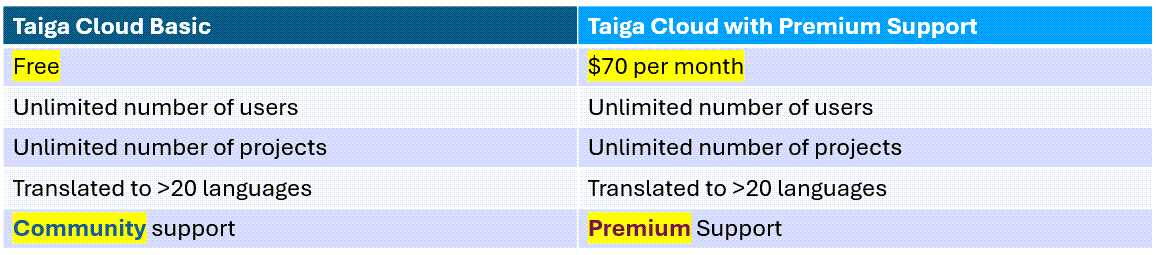
Taiga Cloud deployment: Download and install the Cloud-based version from Taiga’s website.
The Taiga Cloud Basic deployment is free. For technical support, tap into the wealth of help articles, troubleshooting tips, and FAQs on the Taiga Community page. For dedicated, hands-on support from Taiga, purchase Taiga Cloud with Premium Support for $70 per month.
Taiga Cloud deployments
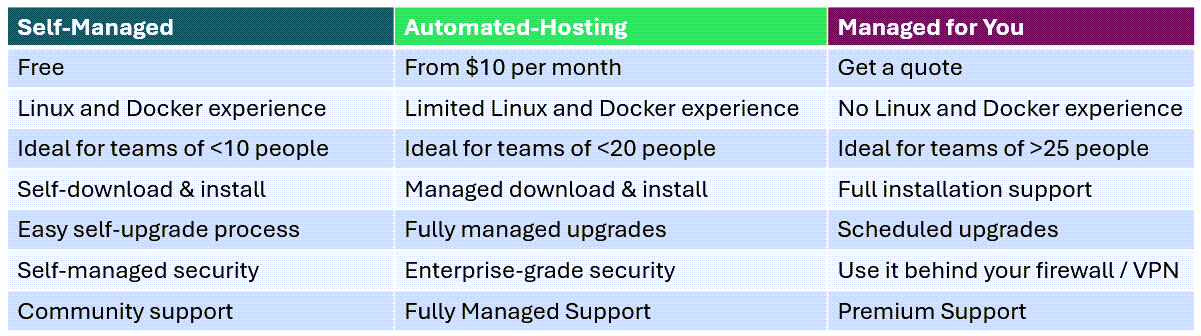
Taiga Self-hosted deployment: Host Taiga on your own or using a third-party platform with varying levels of support.
If you or members of your team have Linux and Docker experience and you want to host Taiga on your own platform, the Self-Managed hosted deployment is for you. It is free, ideal for teams of less than 10 people, and provides an easy self-download, installation, and upgrade process.
For a minimal fee of $10 per month and for teams of less than 20 people, the Automated-Hosting option is optimal, providing a fully managed download, installation and upgrade process, and enterprise-grade security.
For larger teams of more than 25 people and for premium support, check out the Managed for You option. Install this version behind your own firewall and VPN. Installation and upgrades are fully managed and supported.
Taiga Self-hosted deployments
For updated pricing information for all deployment options, see Taiga’s website.
Key features
- Intuitive project management tool for Agile methodologies: Organize, track, and prioritize work based on Agile entities using a user-friendly, intuitive user interface.
- Daily team stand-up management: Drag and drop stories and tasks into clear status swim lanes on a Sprint Taskboard or Kanban board.
- Detailed, granular Agile entity creation: Create user stories with attachments, story points, internal requirements, client requests, and dependencies. Create tasks with attachments, due dates, and priorities.
- High visibility of urgent and blocked work: Urgent and blocked tasks and stories are clearly marked, making it simple to track high-priority items and assist team members facing blockers.
- Customizable Agile entities: Customize epics, user stories, tasks, issue workflows, custom fields, role permissions, integrations, and plugins.
- Wiki content management: Add content to a wiki, including documentation, specs, and out-of-the-box project information.
- Team collaboration and engagement: Highlight team member skills and contributions on the unique Team page, such as nominating a Bug Hunter for issue reporting.
Target audience
This guide is intended for project managers and team leads who manage work using Agile methodologies, including Scrum and Kanban frameworks.
🚀 Getting started
Create your account for the Taiga Cloud Basic deployment option. Then, set up your first project in Taiga.
Create your account
Create your account using the Taiga Cloud Basic deployment option.
For more information about other types of deployment options, see Taiga deployment options.
Procedure
To create your Taiga account, go to the Taiga register account page.
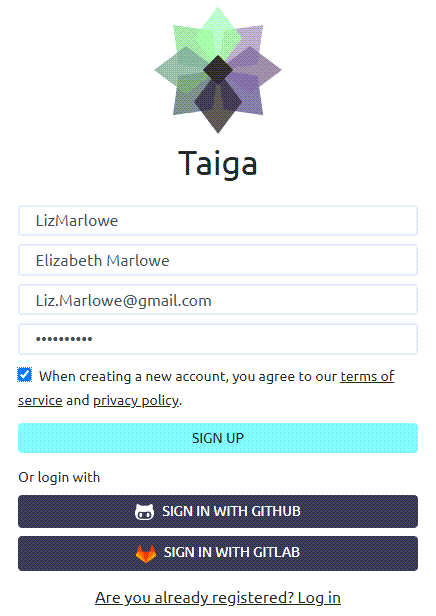
On the Taiga register account page, complete the fields.
Alternatively, you can log in with GitHub or GitLab.
Create your Taiga account
| Field | Description |
|---|---|
| Name | Enter your username. |
| Full Name | Enter your first and last name. |
| Enter your email address. | |
| Password | Enter a unique password. |
| When creating a new account, you agree to your terms of service and privacy policy. | Select this setting. |
Select Sign Up.
After you create an account, you can create your first project.
Create a project
Create a project, which is the top-level container for organizing your team’s work. For example, in a Scrum environment, a project can contain all of your epics, stories, tasks, and issues related to a specific software release.
You can create a Scrum or Kanban project. You can also copy an existing project and modify as required, or import a project from Taiga or other platforms (including Jira, Github, Trello, or Asana).
Before you begin
Procedure
From the Taiga home page, select New Project.
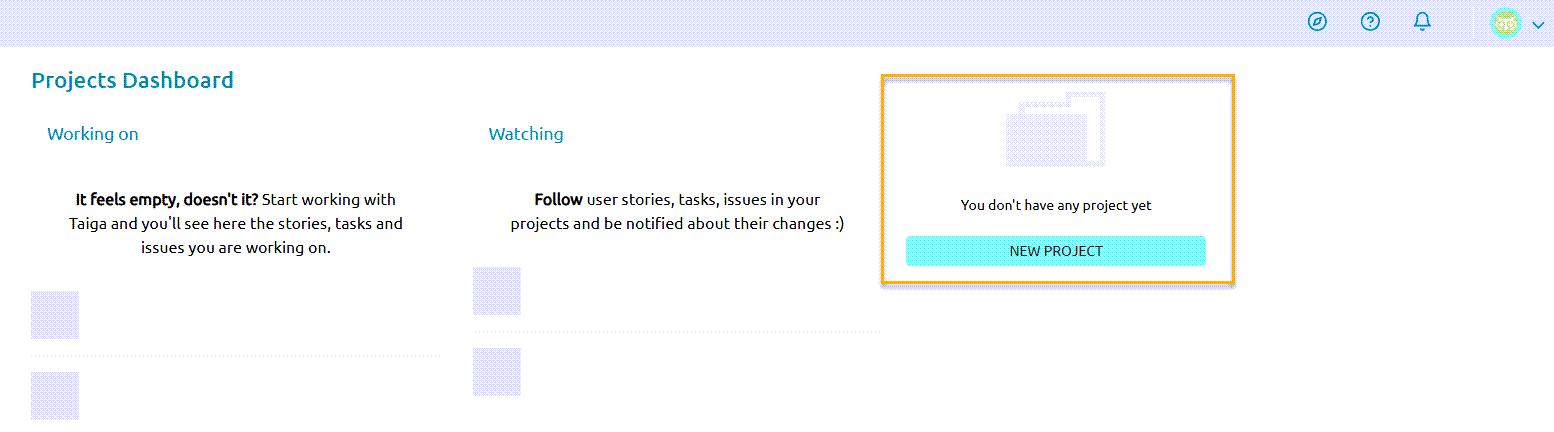
Select new project
On the Create Project screen, select the type of project you want to create.
To get more information about Scrum and Kanban, select the information icon next to each option.
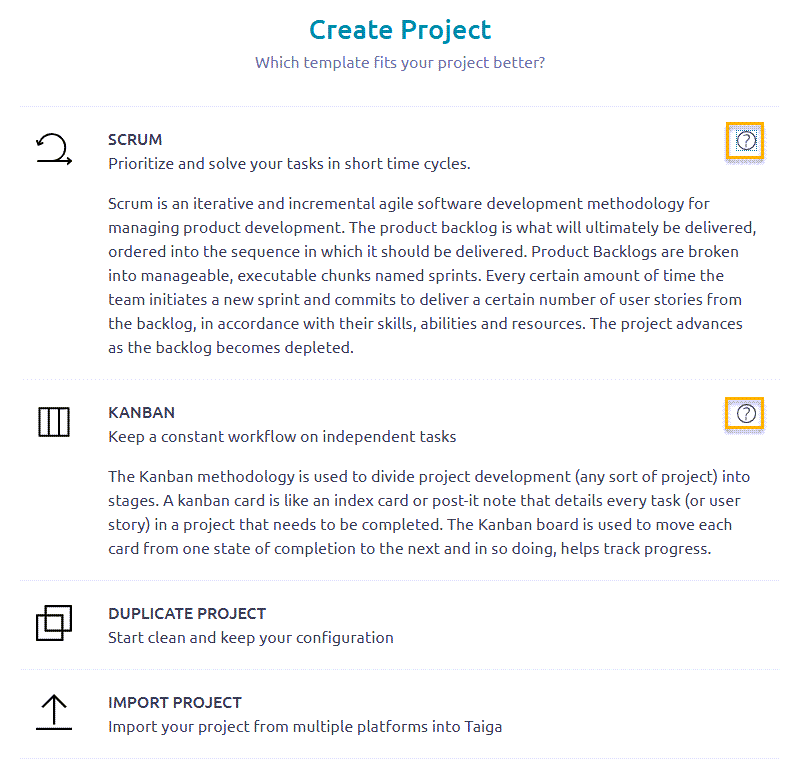
Create project
Project Type Description Scrum Create a Scrum project, which is an iterative and incremental Agile software development methodology for managing product development.
Scrum allows you to prioritize and solve your tasks in short time cycles. All work is managed in the product backlog, which contains tasks that are prioritized according to when the work needs to be delivered.
Product backlogs are broken down into manageable, specific periods of time called sprints. Each sprint contains specific user stories from the backlog that need to be delivered by the end of that sprint. The project advances as the backlog becomes depleted.Kanban Create a Kanban project, which is a workflow-based Agile software development methodology for managing product development.
Kanban allows you to divide project development into stages. Work is managed on Kanban cards, like index cards or post-it notes, where each card details every task or user story that needs to be completed. The Kanban board is used to track progress by moving each card from one stage to the next.Duplicate Project Copy an existing project and modify as required. Import Project Import a project from Taiga or other platforms (including Jira, Github, Trello, or Asana). If you selected Scrum, Kanban, or Duplicate Project, enter your project details.
If you selected Duplicate Project, select the project you want to duplicate, and then enter your project details. If you selected Import Project, select the platform of the project you want to import and browse and select the project to import.
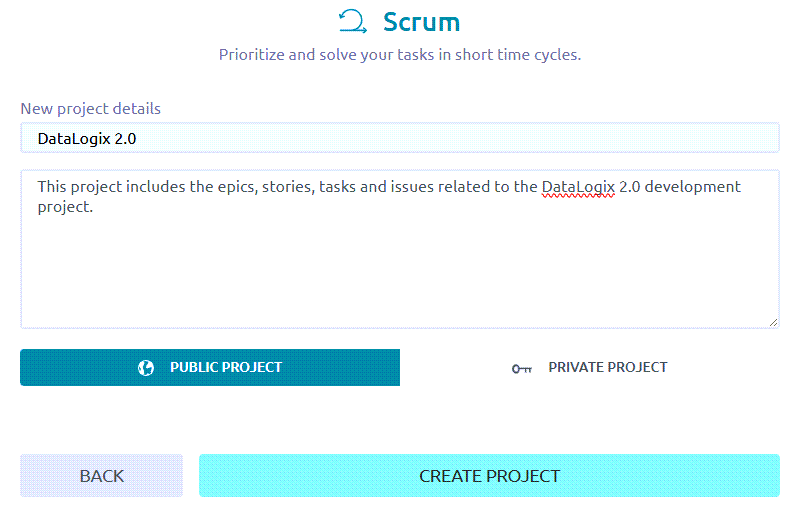
Enter project details
| Field | Description |
|---|---|
| Project Name | Enter a unique name for your project. |
| Project Description | Enter a description for your project, which can include the type of entities the project will include (epics, stories, tasks, etc.) the target software release, and even details about the team members. |
| Public Project / Private Project | Select whether the project is open to all users (Public) or just the project’s team members (Private). The number of public projects you can create is determined by your Taiga subscription plan. For more information, see What’s the difference between public and private projects? |
Select Create Project.
The system creates the new project. From here, you can start populating your project with stories, tasks, and issues.
For example, if you selected a Scrum project, you can start creating user stories for your product backlog (see Create a user story).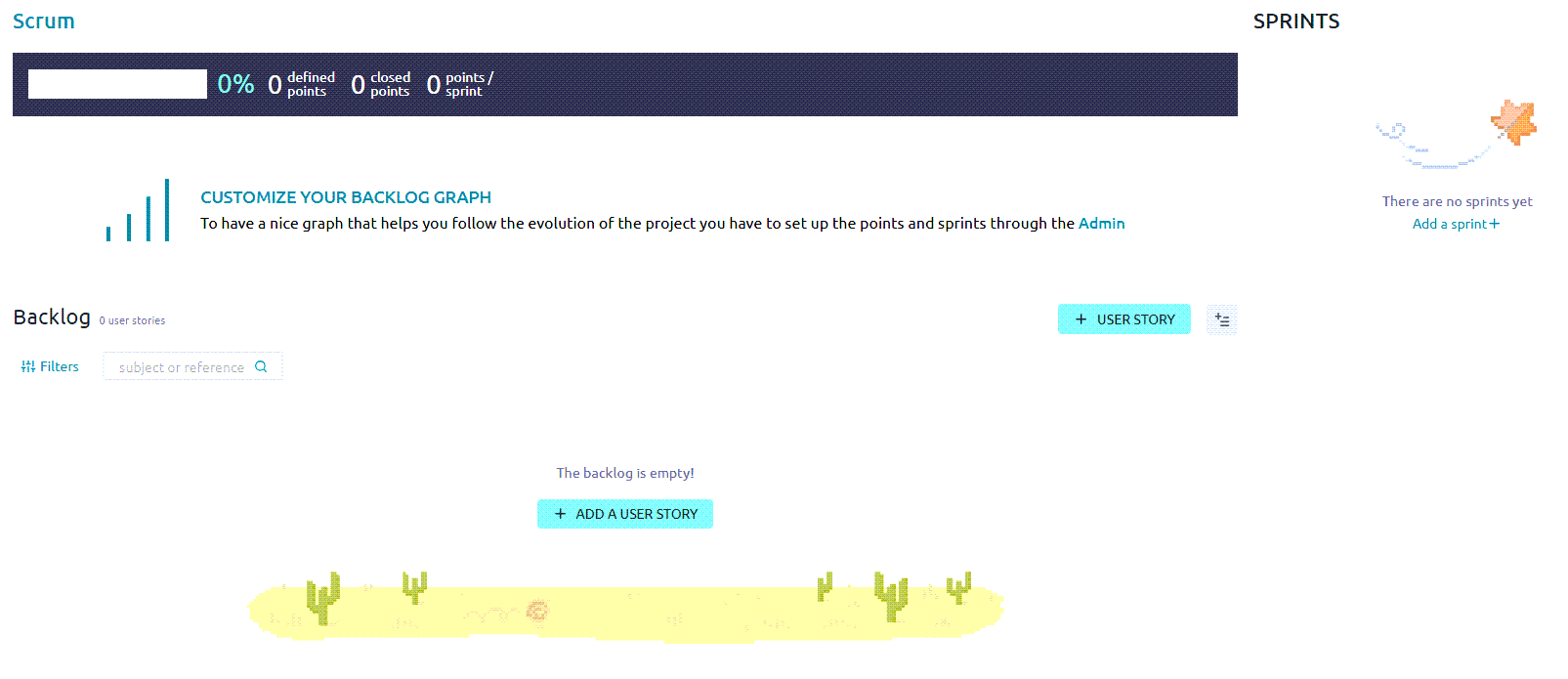
New project created
Before creating your user stories, you might find it useful to define your project settings, including adding team members to your project, customizing specific Agile entities (such as custom fields and adding new story points), and defining project modules and roles. If that is your preferred workflow, see Defining project settings.
⚙️ Defining project settings
Define specific settings for your project, including updating project details, adding team members to the project, defining role permissions, and customizing specific Taiga attributes.
For portfolio purposes, this section includes a curated list of tasks.
Update project details
Update existing project settings (such as name, description, logo, owner, and public/private status). The fields are the same as during creation unless noted. For first-time setup, see Create a project. The items below call out update-only behaviors and additional options.
Before you begin
Procedure
From the Taiga home page, under My projects, select the project you want.
On the project page, from the left sidebar, select Settings.
From the Project tab, select Project Details.
On the Project details page, update any relevant fields.
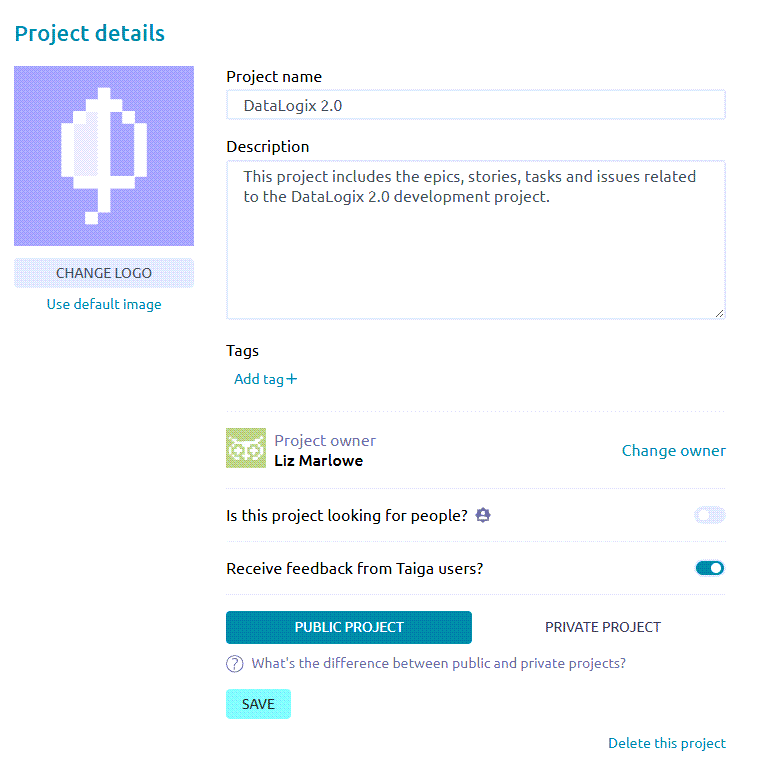
Update project details
Field Notes When Updating Project Name Rename the project. (Same field as during creation.) Project Description Update the description. (Same field as during creation.) Tags Add tags to group, filter, and organize projects. Tags appear on the dashboard for quick scanning. Project Owner Reassign ownership to another team member. Is this project looking for people? Toggle On to advertise you’re seeking teammates and specify desired profiles/skills. Receive feedback from Taiga users? Toggle On to allow feedback from the broader Taiga community. Public Project / Private Project Change visibility. For limits on public projects, see Taiga deployment options. For field definitions shown during project creation (such as visibility and description), see Create a project.
Select Save.
The application saves your updates.
If needed, you can also delete the project from this screen.
Add new members
Add new members whom you want to contribute to your project. Typically, this includes people who have the skills and experience to do the stories and tasks you created (or plan on creating) in the backlog. It can also include managers, like a scrum master, who manages the team.
Procedure
From the Taiga home page, under My projects, select the project you want.
On the project page, from the left sidebar, select Settings.
Select the Members tab.
Select + New Member.
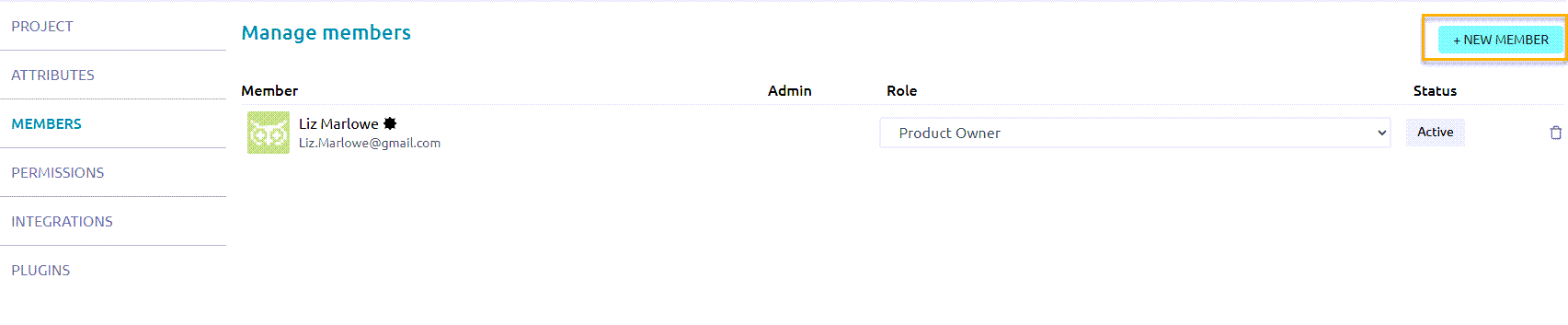
Select + New Member
Enter the email address of the new member and select the icon.
On the New Member screen, select the role of the new member (such as UX, Design, Front, Back, Product Owner, and Stakeholder).
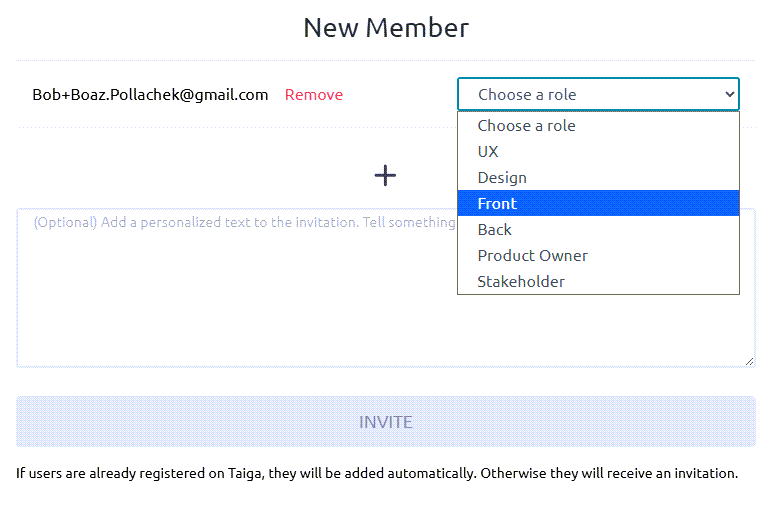
Enter role for new member
Optional. Add a personalized text to the invite that will be sent to the new member. For example: Welcome to the DataLogix 2.0 project! We are excited to invite you as a new member to contribute to this project. Looking forward to working with you!
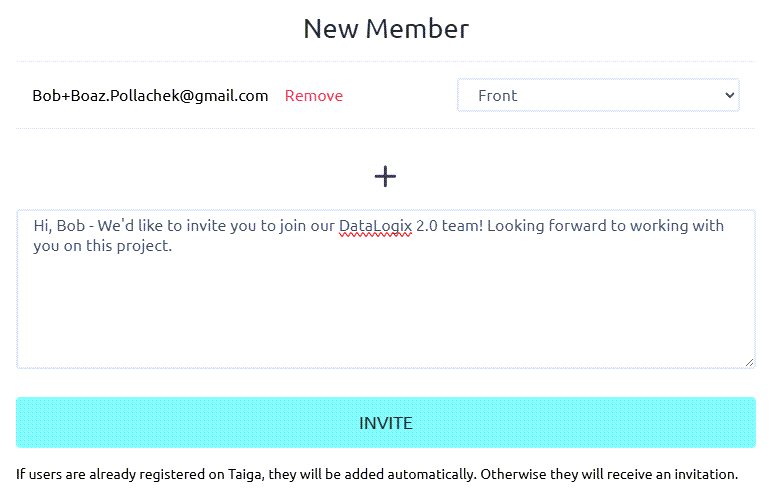
Invite new member
Select Invite.
If users are already registered on Taiga, they will be added automatically to the project. Otherwise, they will receive an email invitation. On the Manage members screen, a row is added listing their name, email address, and assigned role with a Pending status. You can resend the invitation to any member with a Pending status.

Pending member
Repeat steps 4-8 for all new members you want to invite to the project.
When members have accepted the invite (or are added automatically), their status is changed to Active. If needed, you can change their role or enable them with admin permissions.
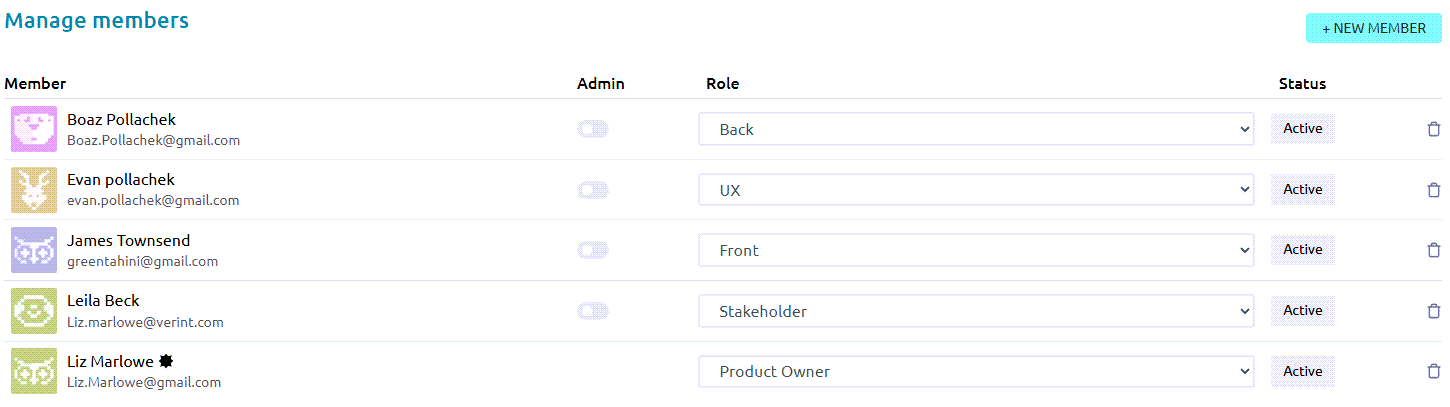
Active members
If needed, you can delete members from this screen by selecting the Delete member icon.
Define role permissions
You can update the default permissions for defined roles (including Design, Front, Back, Product Owner, Stakeholder, and External User roles). In addition, you can create new roles and define specific permissions for these roles.
Role permissions help control who can create, edit, or delete Agile entities, such as stories, tasks, and sprints.
Procedure
From the Taiga home page, under My projects, select the project you want.
On the project page, from the left sidebar, select Settings.
Select the Permissions tab.
To update the default permissions for a defined role, select the role (such as Design, Front, Back, etc.).
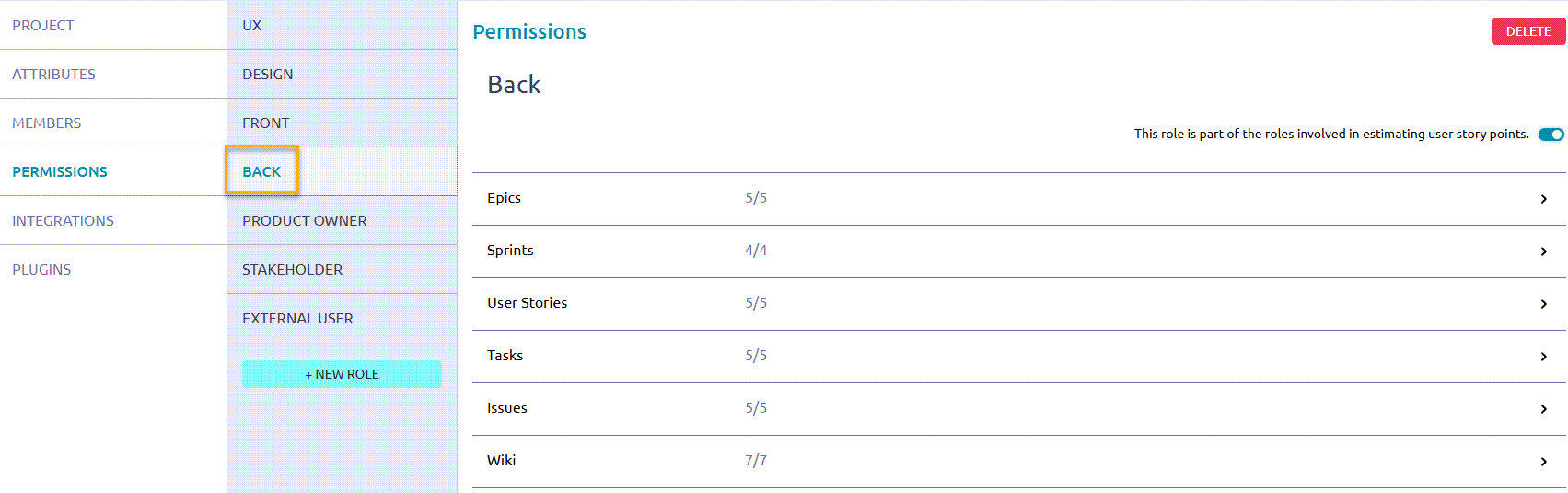
Select role to update permissions
On the Permissions page, complete the fields.
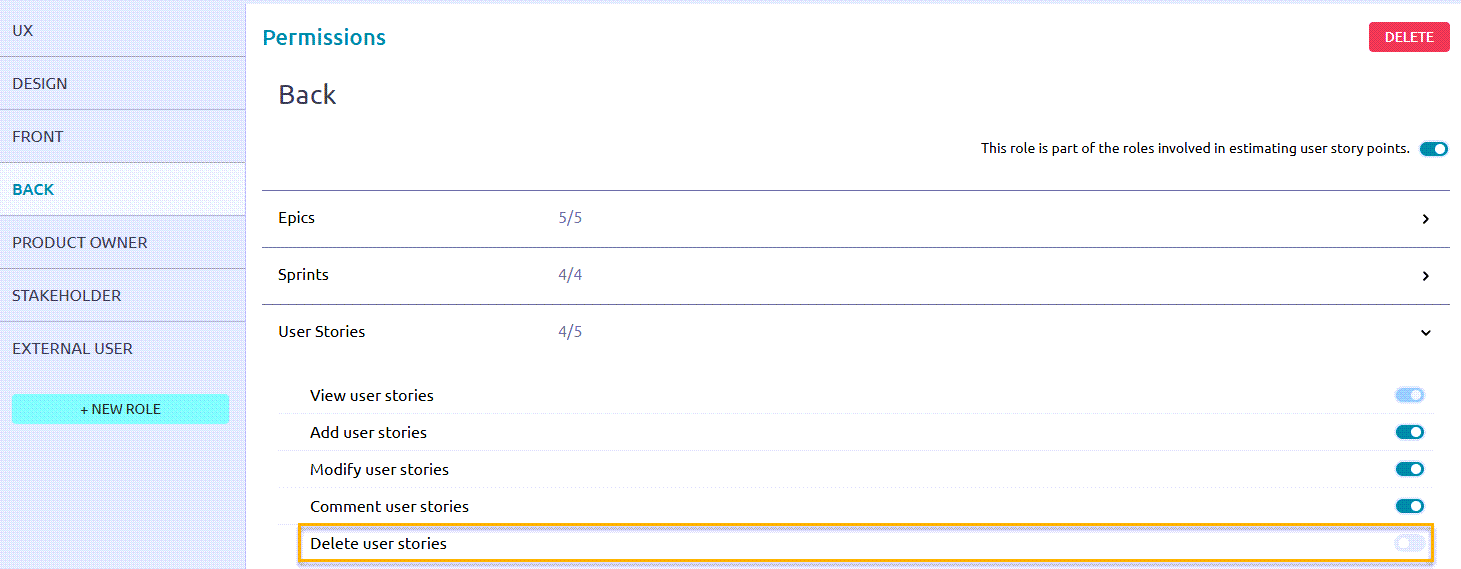
Update permissions for role
Field Description This role is part of the roles involved in estimating user story points. Do one of the following: - To allow the role to be involved in estimating user story points, toggle this setting to the On position.
- If you do not want the role to be involved in estimating user story points, toggle this setting to the Off position.
Agile entities (Epics, Sprints, User Stories, Tasks, etc.) To update the permissions for this role for a specific entity, select the entity.
For example, select User Stories.Permissions Enable or disable the relevant permissions by toggling the settings to the On or Off positions.
For example, for the Back role, toggle the setting, Delete user stories, to the Off position. As a result, the member assigned to the Back role will not be able to delete user stories in the project.To set specific permissions for any user, including search engines, select the External User role and update permissions accordingly.
To create a new role, select + New Role and set permissions for the new role.
Create a custom field
When creating a new Agile entity in Taiga (such as an epic, user story, or task), there are default fields that define the entity. For example, when creating a new user story, some of the default fields include Subject, Description, and Points. To customize these entities for your project, you can add custom fields.
Procedure
From the Taiga home page, under My projects, select the project you want.
On the project page, from the left sidebar, select Settings.
From the Attributes tab, select Custom Fields.
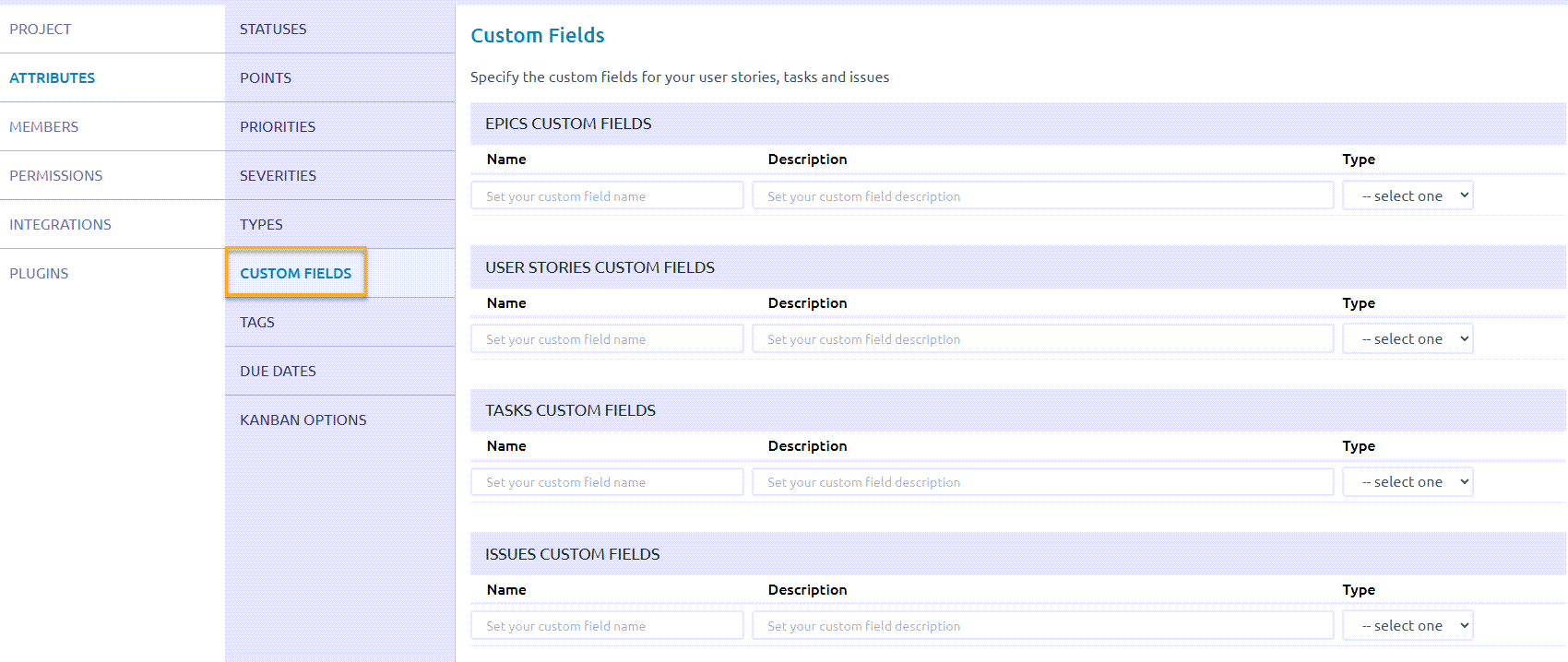
Select custom fields
For the entity for which you want to add a custom field, complete the fields.

Add custom field
Field Description Name Enter the name of the custom field.
For example, if you are adding a field for acceptance criteria for user stories, enter: Acceptance CriteriaDescription Enter a description for the custom field.
For example, for Acceptance Criteria: Set of clear, measurable conditions that a user story must satisfy to be considered complete and accepted by the product owner or stakeholders.Type Select the valid input type for the field.
Valid values include: Text, Multi-line, Rich text, Date, URL, Dropdown, Checkbox, Number.To save your changes, hover over the row and select Update custom field.
To edit or delete the custom field, after you save it, hover over the row again and select one of the following icons:
Edit custom field
Delete custom field

Edit or delete custom field
Add a new issue type
By default, the types of issues included in a project include Bug, Question, and Enhancement. You can add new issue types to your project, as required.
For example, you might want to add an issue type that is related to work that is dependent on another member or team. For this purpose, you can add a new issue type called Dependency.
Procedure
From the Taiga home page, under My projects, select the project you want.
On the project page, from the left sidebar, select Settings.
From the Attributes tab, select Types.
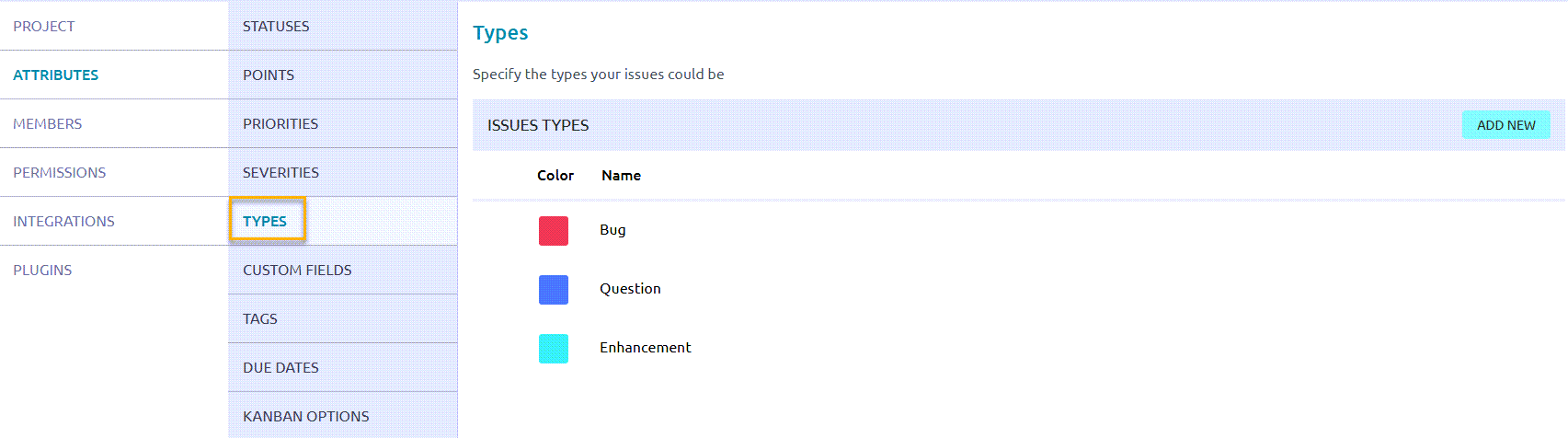
Select types
On the Types page, select Add New.
In the new row that appears:
In the Color field, select a color that identifies the issue type. (Alternatively, enter the hexadecimal color code.)
In the Name field, enter a name for the new issue type.
To save your changes, hover over the row and select the checkmark.
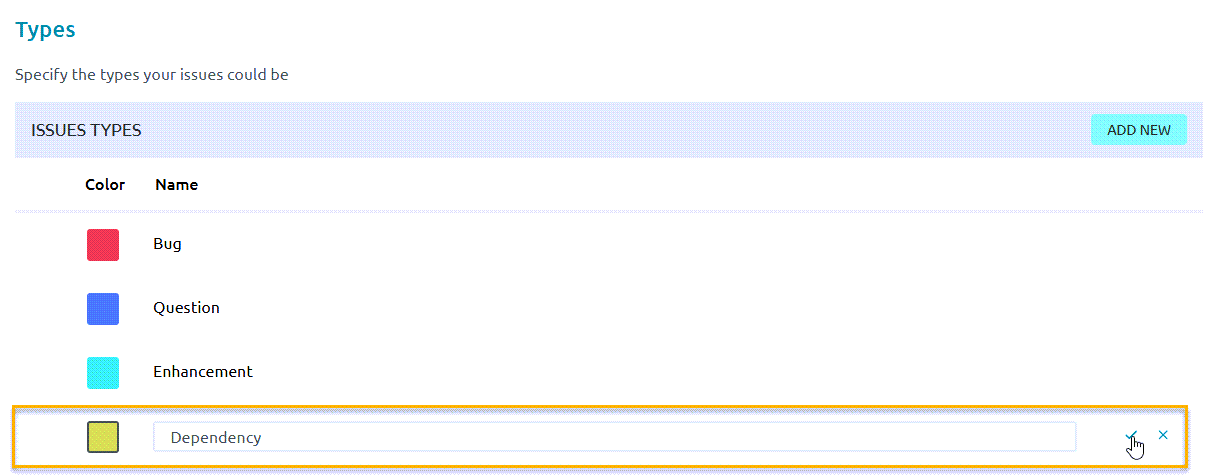
Save issue type
🔄 Scrum project workflow
In Scrum, work typically moves through two main phases:
Backlog Management: Prepare and prioritize work by creating and refining epics, user stories and tasks.
Sprint Execution: Create and plan sprints, assign stories and tasks to members, and track story and task progress through to completion.
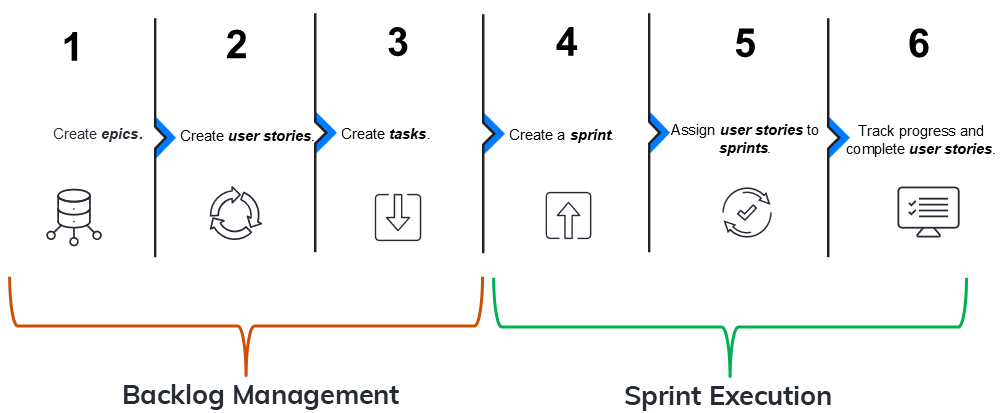
Scrum project workflow
The following table summarizes each step in the workflow.
| Seq.# | Step | Phase | Description | Example |
|---|---|---|---|---|
| 1 | Create epics | Backlog Management | Create epics, which group related user stories. Together, the user stories in an epic encapsulate work towards a specific product development. | An epic called User Management Accessibility Redesign includes user stories that define development related to accessibility features in the User Management application. |
| 2 | Create user stories | Backlog Management | Within an epic and from the backlog, create user stories that define specific development needed to accomplish the goal of the epic. | In the epic called User Management Accessibility Redesign, there’s a user story called Change UI Labels, which defines changing the UI text headings to comply with WCAG requirements. |
| 3 | Create tasks | Backlog Management | Within each user story, create tasks, which break up the story work into smaller, manageable chunks that different members of the team can work on. | For the user story, Change UI Labels, there are 3 tasks: Propose New UI Labels, Update Text Labels in DB, and Test New UI Labels. Each task is assigned to a different member of the team. |
| 4 | Create a sprint | Sprint Execution | Create a sprint, a timeboxed period for completing user stories. Typically, multiple sprints are created well in advance of their start dates. | A sprint called DLogix-S1 is a two-week sprint, starting on 1/12 and ending on 1/19. |
| 5 | Assign user stories to a sprint | Sprint Execution | From the backlog, according to deployment priorities, related work, and development dependencies, determine which user stories should be assigned to upcoming sprints, and assign them accordingly. | For the sprint, DLogix-S1, assign the following user stories: Change UI Labels, Create New Filters, and Enhance Search. |
| 6 | Track progress and complete user stories | Sprint Execution | During a sprint, track the status of user stories on a sprint taskboard. During the daily standups, discuss any blockers, issues, and dependencies, and try to resolve them so that members can complete the work defined in the relevant stories. At the end of a sprint, all stories should have a completed status. | One week into the DLogix-S1 sprint, the stories, Change UI Labels and Create New Filters are In Progress, and Enhance Search has a dependency on another team that is currently being resolved. |
📋 Scrum backlog management
During backlog management, you prepare and prioritize work by creating the key entities you will use to manage work on a daily basis: epics, user stories, and tasks. Managing these entities and following the Scrum workflow helps you organize and prioritize work, with the goal of delivering value within the defined timebox.
Create an epic
Create an epic, which groups related user stories. Together, the user stories in an epic encapsulate work towards a specific product development.
For example, an epic called User Management Accessibility Redesign includes user stories that define development related to accessibility features in the User Management application.
Before you begin
Review the Scrum project workflow
Procedure
From the Taiga home page, under My projects, select the project you want.
On the project page, from the left sidebar, select Epics.
Select + Add Epic.
On the following screen, enter your epic details.
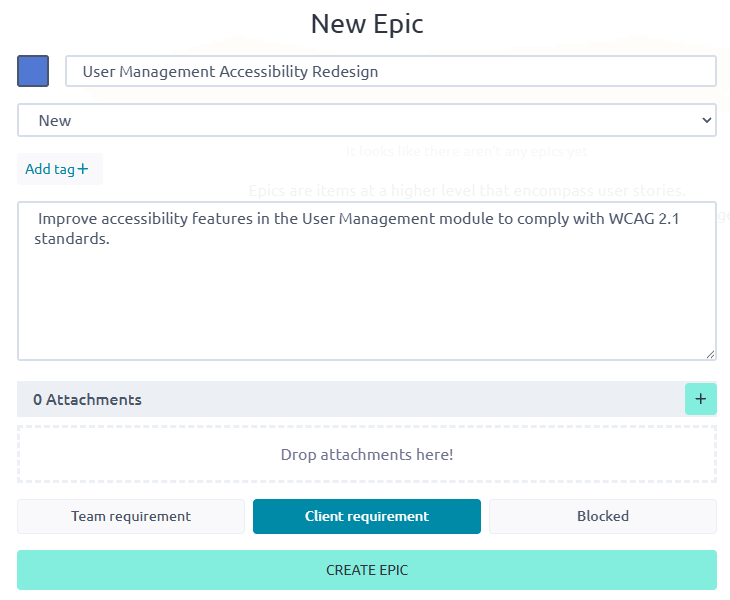
Enter epic details
Field Description Color ID Select a color that identifies the epic.
Alternatively, enter the hexadecimal color code.Epic Name Enter a unique name for your epic.
For example: User Management Accessibility RedesignEpic Description Enter a description for your epic, which should describe the type of product development for the epic.
For example: Improve accessibility features in the User Management module to comply with WCAG 2.1 standards.Attachments If desired, upload or drop any relevant attachments, such as feature specs, customer requirements, etc. Team requirement / Client requirement / Blocked Select one of the following: - Team requirement: Work defined by user stories in the epic is work the development team feels is necessary but it is not a direct client request.
- Client requirement: Work defined by user stories in the epic is the result of a direct client request. .
- Blocked: Work defined by the user stories in this epic currently cannot be done, due to an external dependency or issue preventing its progress.
Select Create Epic.
The system creates the new epic, and displays it in a new row on the Epics screen.

New epic created
Field Description Name Name of the epic. Project Project associated with the epic.
A blank value indicates that the project is the one in which the epic was created (the current project). If the epic was assigned to a project other than the one in which it was created, the name of the project is displayed in this field.Sprint Sprint to which the epic is assigned.
Note: This field is often blank because epics span multiple sprints. They are not single-sprint items. Instead, epics are linked to their specific user stories or tasks, which get assigned to sprints.Assigned Member of the project to which the epic is assigned.
By default, this field is blank. Typically, this is assigned to the specific team member who is responsible for the high-level goal or initiative of the epic.Status Status of the epic.
By default, a new epic is set to New. Can be set to New, Ready, In Progress, Ready for Test, and Done.Progress Calculated rollup that reflects the completion status of all associated user stories (or Kanban cards) linked to the epic.
This is not a manually editable field.
What to do next?
Create a user story
Create a user story that defines specific development needed to accomplish the goal of the epic.
For example, in the epic called User Management Accessibility Redesign, create a user story called Change UI Labels, which defines changing the UI text headings to comply with WCAG requirements.
There are two ways to create user stories—from the Epics dashboard or from the backlog. To emphasize the value of the project workflow, this procedure describes how to create user stories from the Epics dashboard. To create a user story from the backlog, select Scrum > Backlog, select + User Story, and associate the user story with the relevant epic.
Before you begin
Procedure
Select the epic for which you want to create a user story.
Under Related user stories, select the + icon.
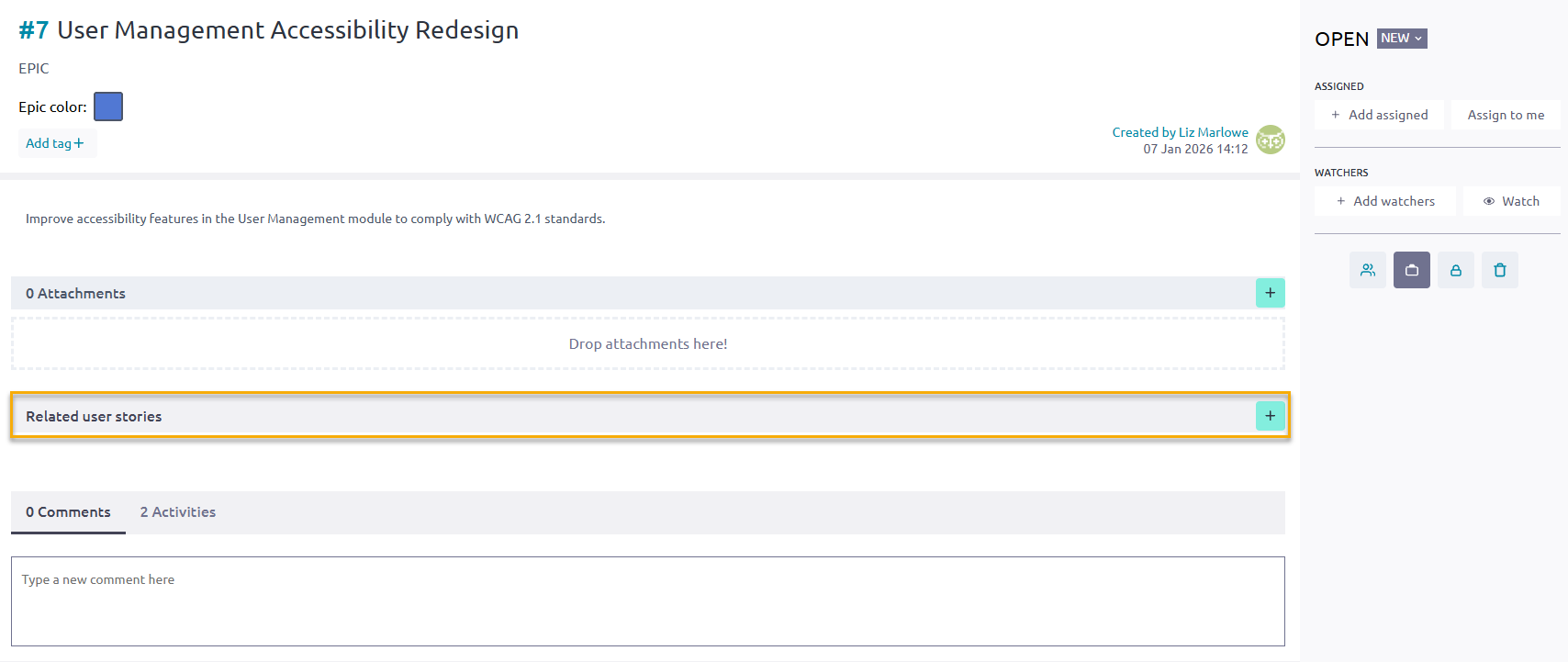
Select related user stories from epic
On the Create a relationship with screen, complete the fields.
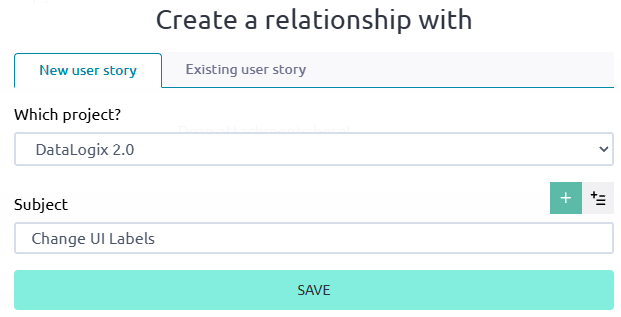
Enter new story details
Field Description New user story / existing user story Do one of the following: - To create a new story for the epic, select New user story.
- To select an existing story for the epic, select Existing user story.
Which project? Select the project with which you want to associate the user story. Subject Enter the name of the story. Select Save.
The system saves the story under Related user stories for the epic.
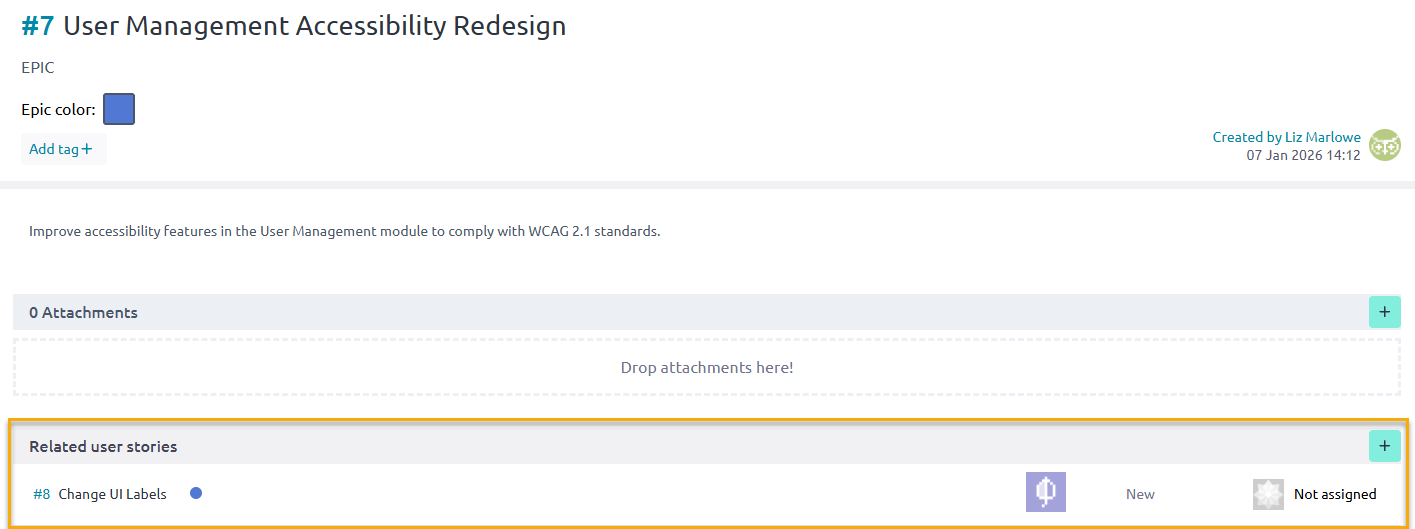
New story created
Now that you created the story, select it again and complete the additional fields.
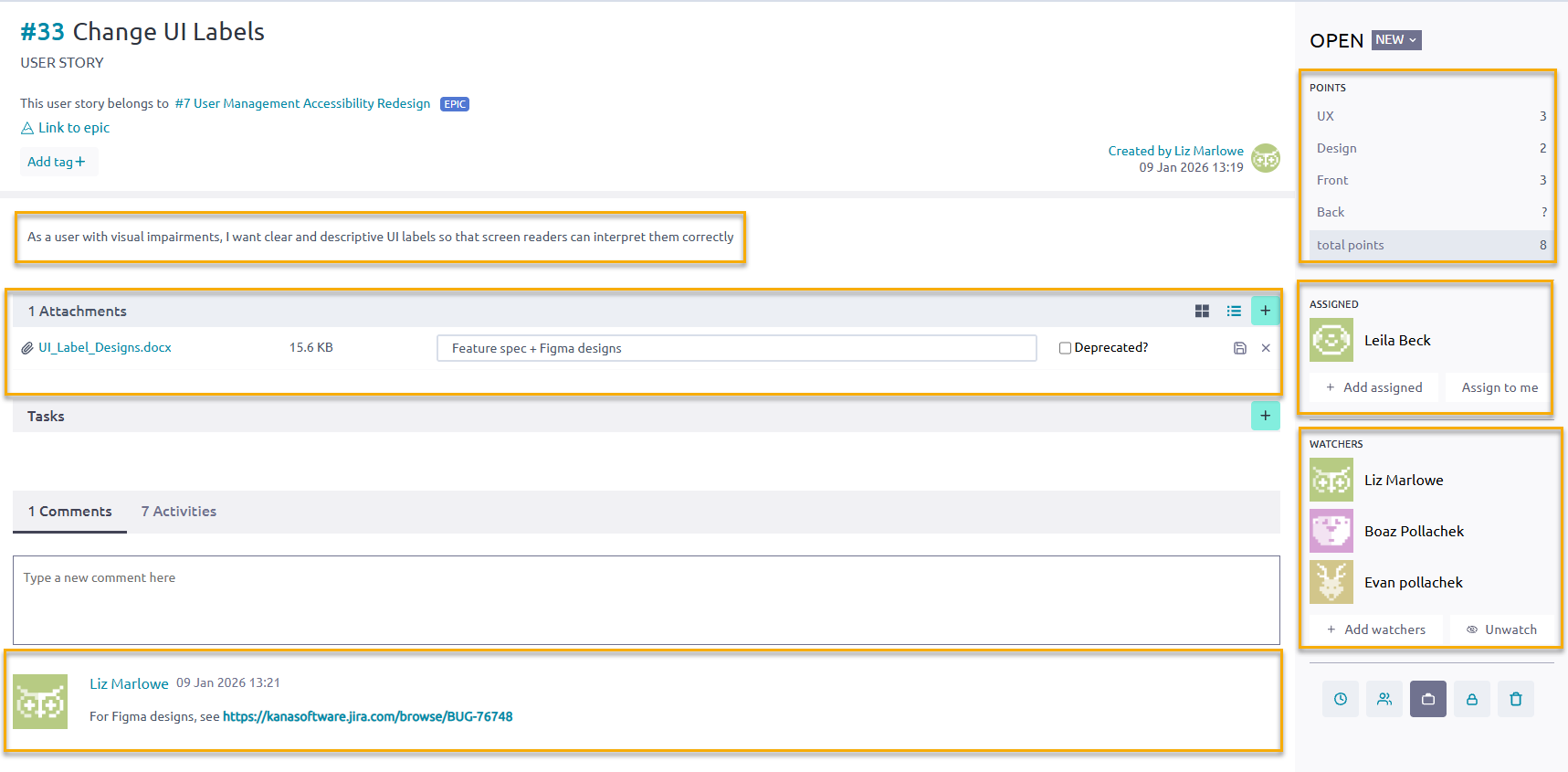
Add story details
Field Description Description Enter a description for the story, and select Save.
To write the description, use the Connextra template: “As a {user role}, I want to {achieve a goal/action} so that {I get a value or benefit}. For example: As a user with visual impairments, I want clear and descriptive UI labels so that screen readers can interpret them correctly.Attachments Upload any relevant files.
For example, this can include product specs, feature descriptions, etc.Comments Enter any relevant comments about the story.
For example, this can include URLs, information about dependencies, potential issues, etc.Points Enter the relevant story points for the relevant development areas.
For example, for a UI update, enter points for UX, Design, and Front.Assigned Select + Add assigned and select a member from the list. To assign the story to yourself, select Assign to me. Watchers Select + Add watchers and select the members you want to watch the story. These members will receive email notifications when there are story updates, and when the story’s status changes. To create more stories for the epic, repeat these steps for the additional stories.
What to do next?
Create a task
Within each user story, create a task, which breaks up story work into smaller, manageable chunks that different members of the team can work on.
For example, for the user story, Change UI Labels, there are 3 tasks: Propose New UI Labels, Update Text Labels in DB, and Test New UI Labels. Each task is assigned to a different member of the team.
Before you begin
Procedure
On the User Story screen, for Tasks, select the + icon.
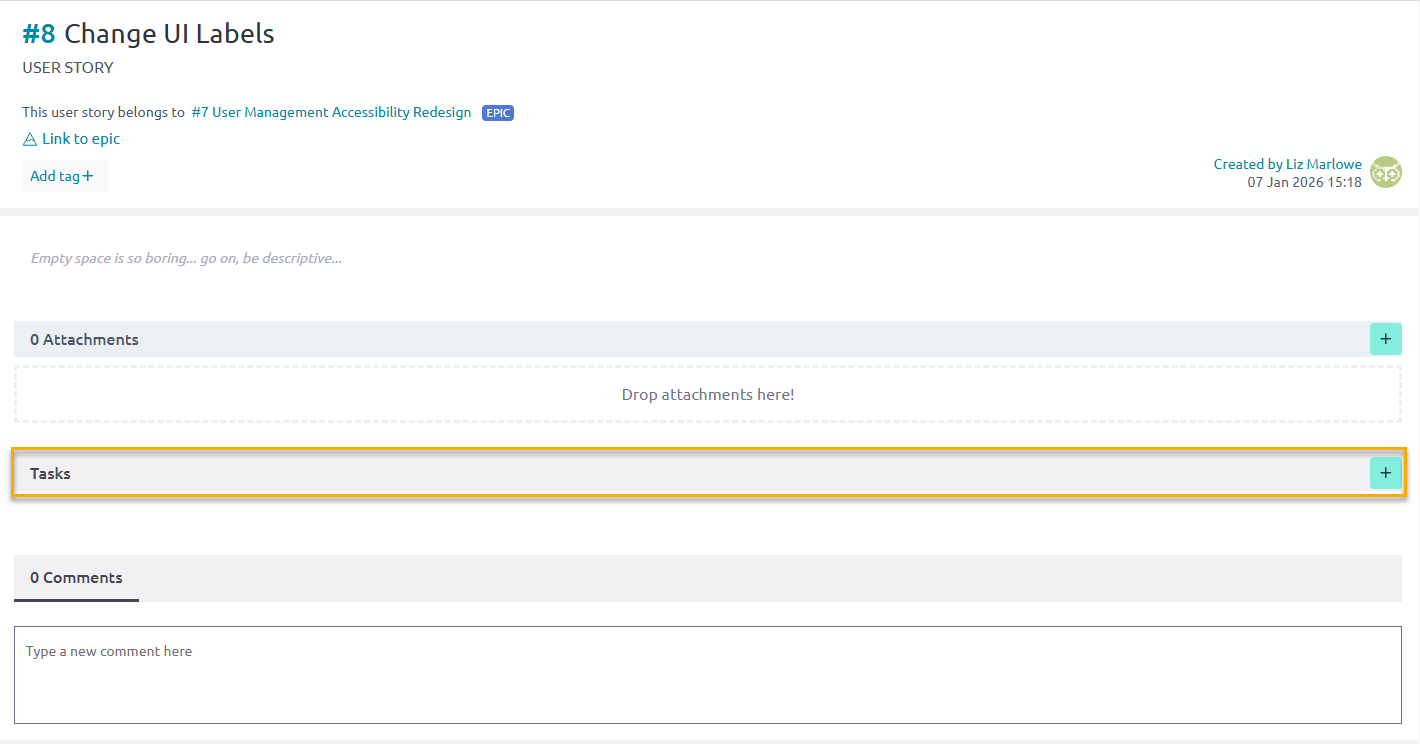
Select to create a new task
Under Tasks, in the new row, do the following:
Enter a name for the task. For example: Propose new UI labels that meet WCAG guidelines.
From the drop-down menu next to the name, select the status of the task. By default, the status is New. (You can also update the status during the sprint on the sprint task board.)
From the third drop-down menu, select the task, assign it to a member, and select Add.
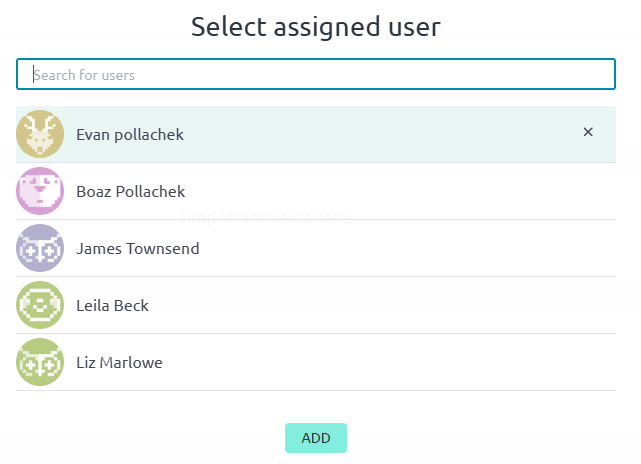
Select assigned user
Hover over the row and select Save.

Save new task
The system saves the new task.
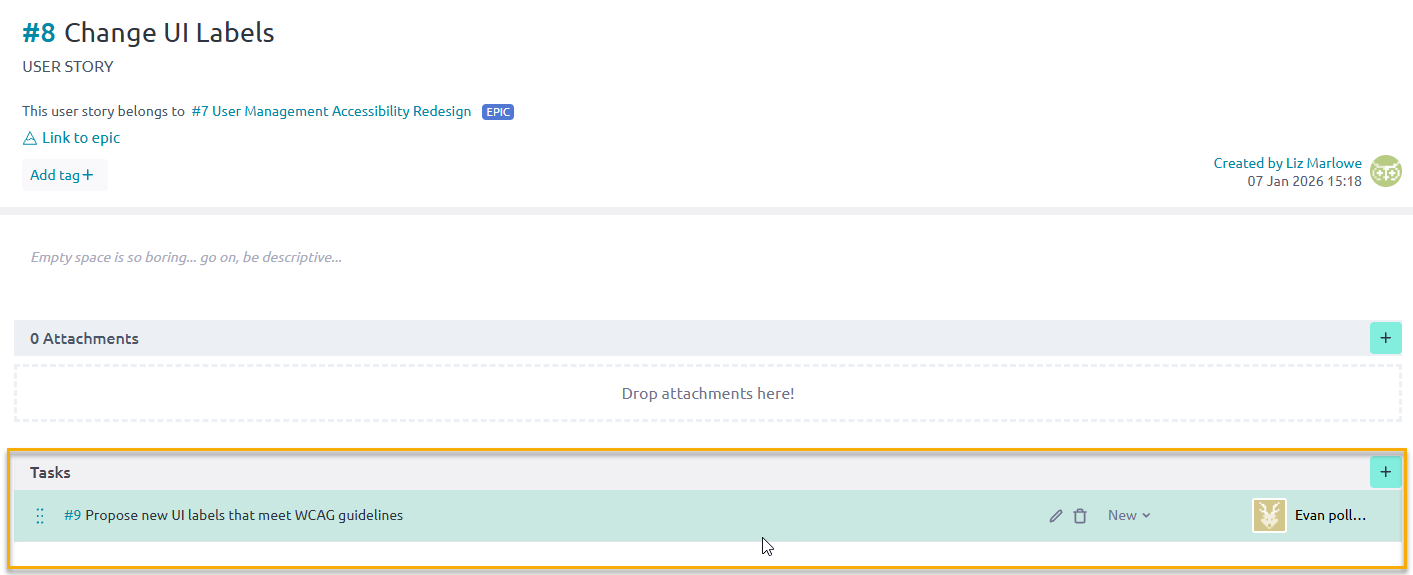
New task created
To create more tasks for the story, repeat these steps for the additional tasks.
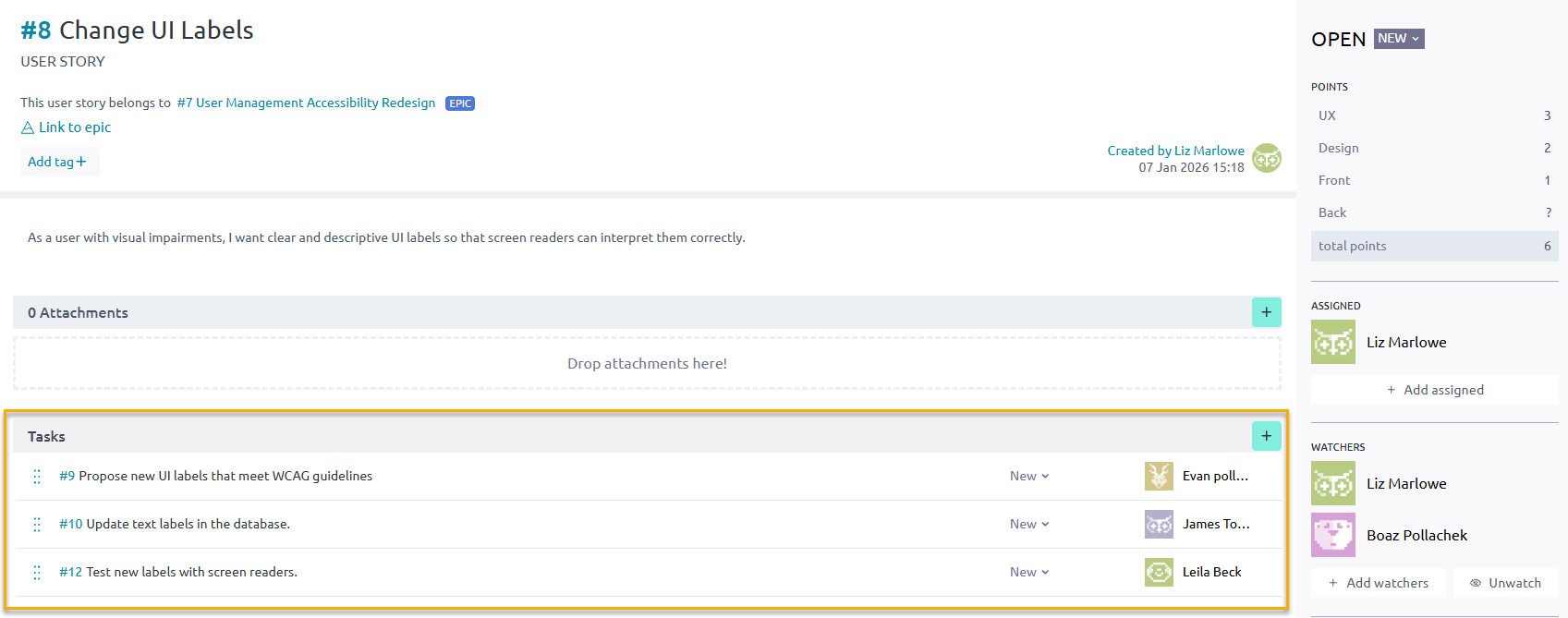
Additional tasks created
What to do next?
🏃♂️ Scrum sprint execution
During sprint execution, you deliver the work that was prepared during backlog management. This phase includes planning sprints, assigning prioritized user stories to the sprint backlog, and coordinating daily progress.
Teams work collaboratively to complete stories within the sprint’s timebox, resolve blockers, and track progress using task boards or burndown charts. At the end of the sprint, completed work is reviewed and demonstrated, and the team reflects on improvements during the retrospective.
Create a sprint
Create a sprint, a timeboxed period for completing user stories. Typically, multiple sprints are created well in advance of their start dates.
Before you begin
Complete all steps in Scrum backlog management.
Procedure
On the project page, from the left sidebar, select Scrum and Backlog.
The backlog displays all existing user stories.
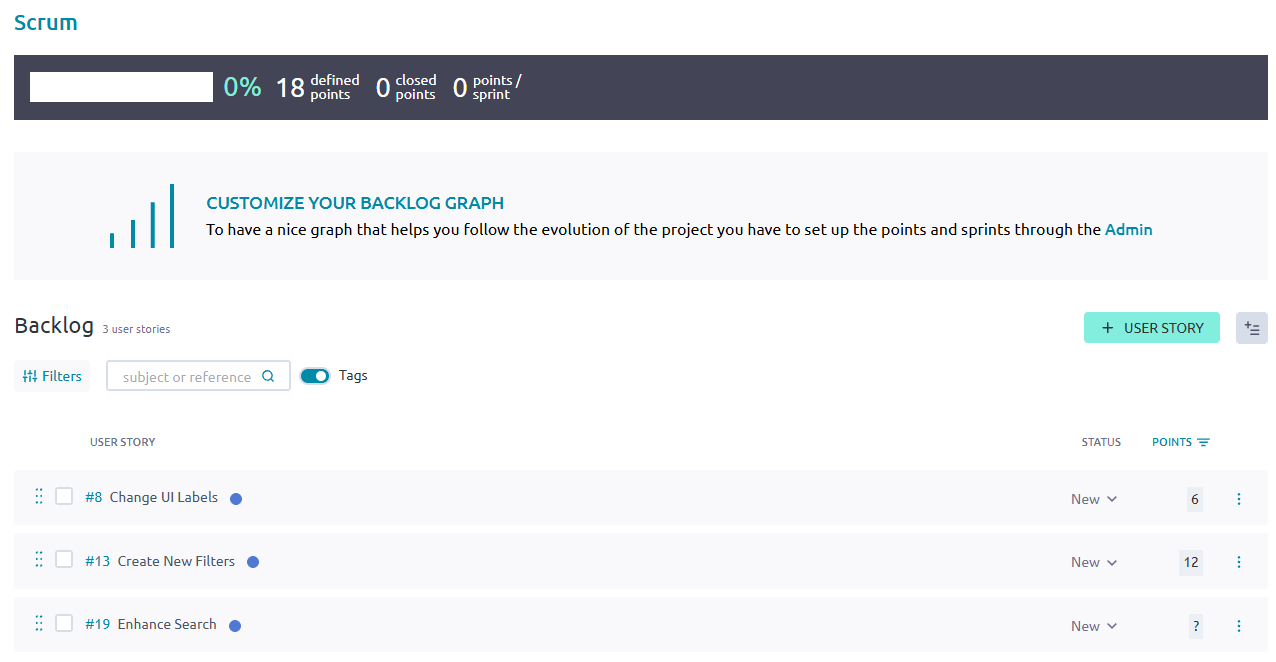
User stories in the backlog
From Sprints, select Add +.
On the New sprint screen, enter the name of the sprint and the start and end dates, and select Save.
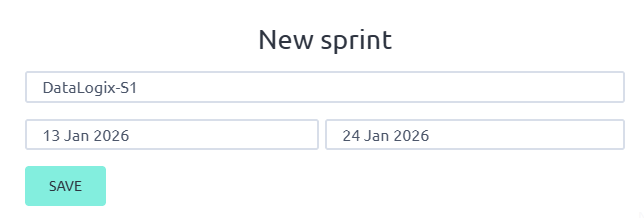
Create new sprint
Select Save.
Under Sprints, the new sprint is now displayed.
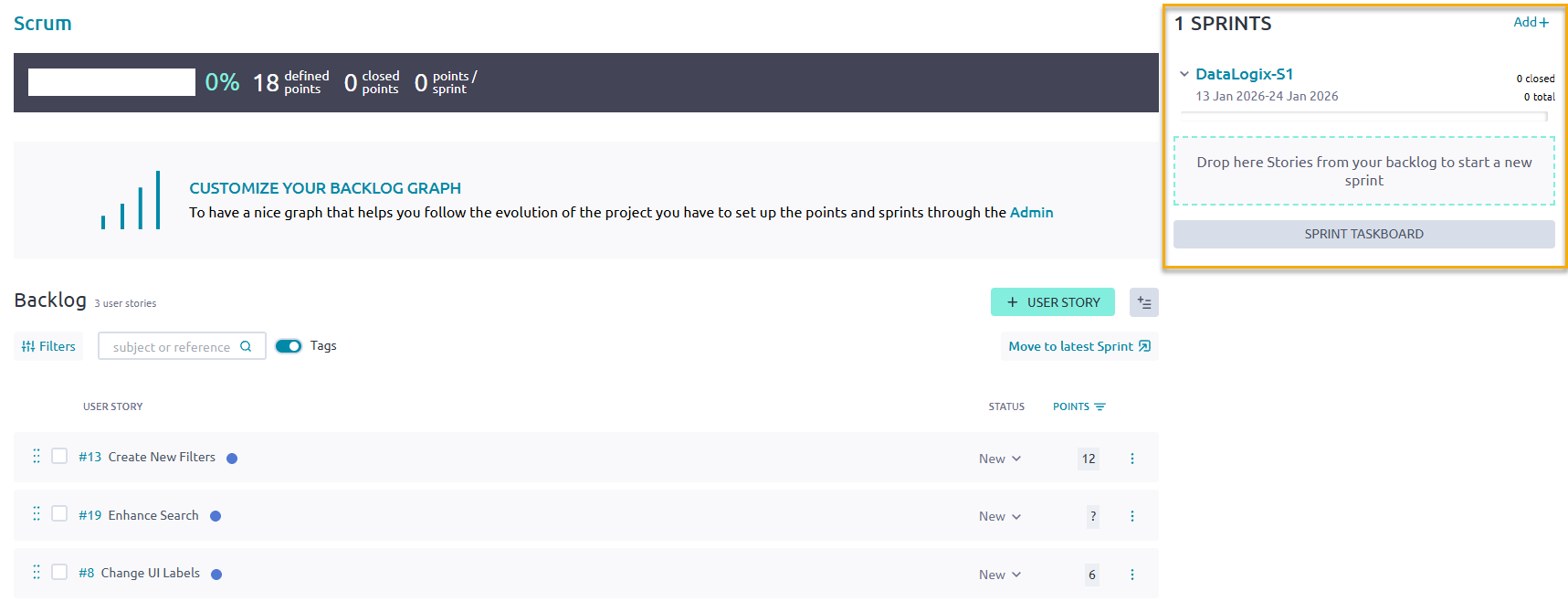
New sprint created
What to do next?
Assign user stories to a sprint
Assign user stories to a sprint
From the backlog, according to deployment priorities, related work, and development dependencies, determine which user stories should be assigned to upcoming sprints, and assign them accordingly.
Before you begin
Procedure
From the Backlog, select the user stories you want to move to the sprint you created.
Do one of the following:
If the sprint to which you want to assign the stories is the latest sprint, select Move to latest sprint.
Alternatively, drag and drop the selected stories to the sprint you created.
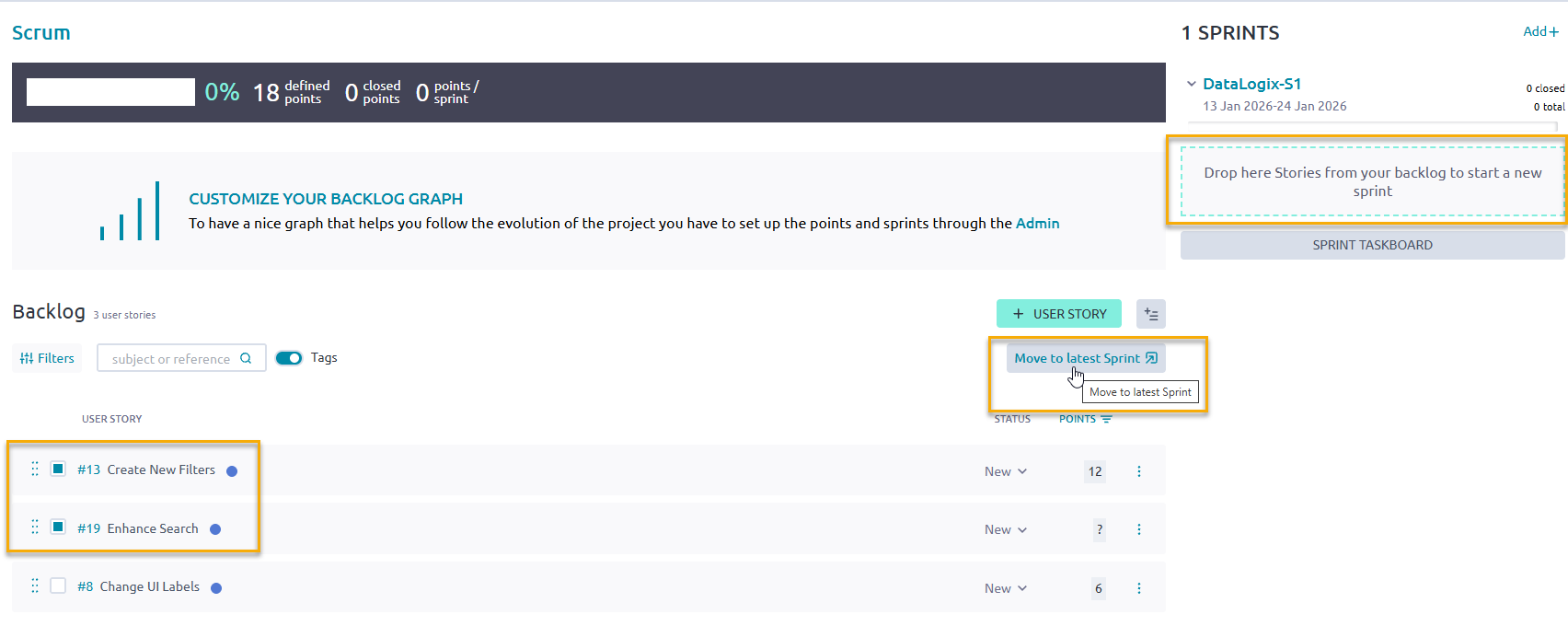
Move stories to sprint
The stories you selected are now assigned to the sprint.
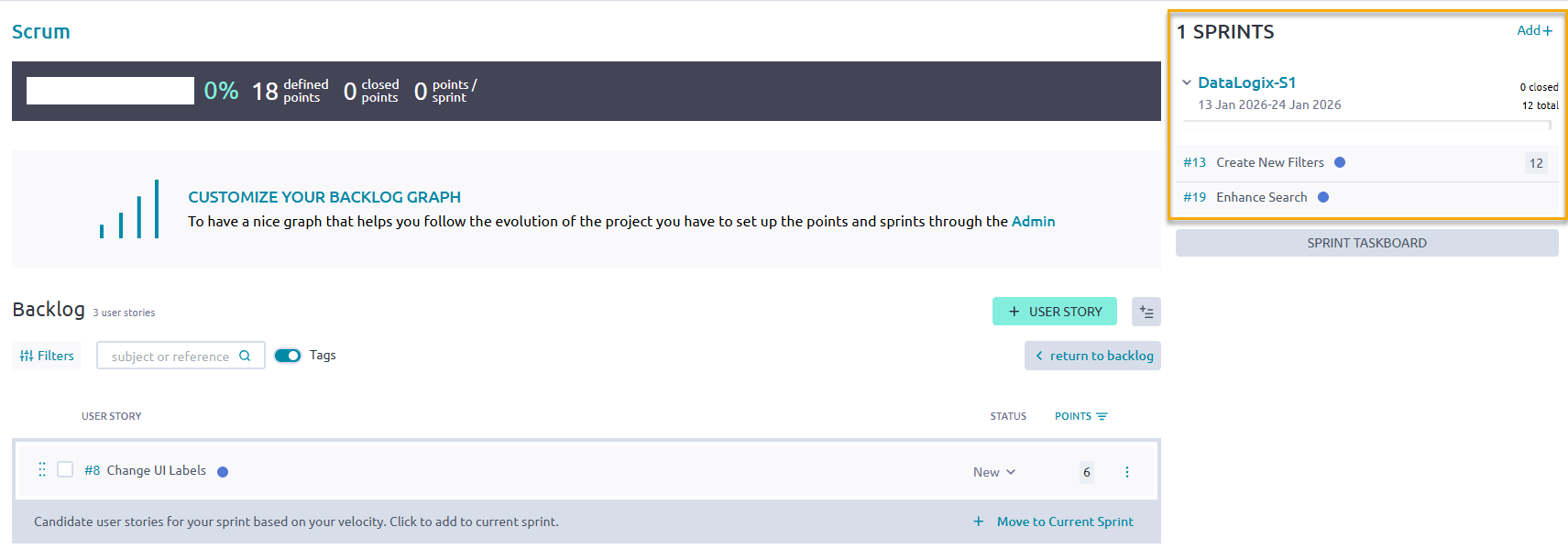
Stories assigned to sprint
The application calculates your velocity based on your story points allocated to the sprint. If you can add additional stories to the sprint without exceeding your velocity, the system prompts you to move the candidate user stories to the current sprint.
To move candidate user stories to the current sprint, select Move to Current Sprint.
The system updates the assigned stories to the sprint.
What to do next?
Track progress and complete user stories
Track progress and complete user stories
During a sprint, track the status of user stories on the Sprint Taskboard.
During the daily standups, discuss any blockers, issues, and dependencies, and try to resolve them so that members can complete the work defined in the relevant stories. At the end of a sprint, all stories should have a completed status.
Before you begin
Assign user stories to a sprint
Procedure
From the Backlog, select Sprint Taskboard.
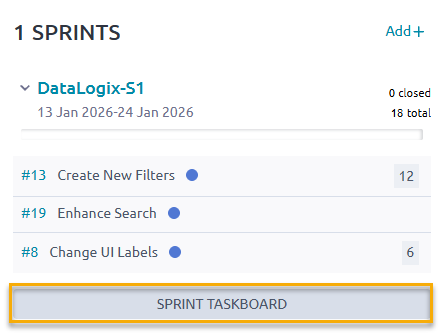
Select sprint taskboard
Alternatively, from the left sidebar, select Scrum > {Sprint Name}. For example, select Scrum > DataLogix-S1.
View the Sprint Taskboard.
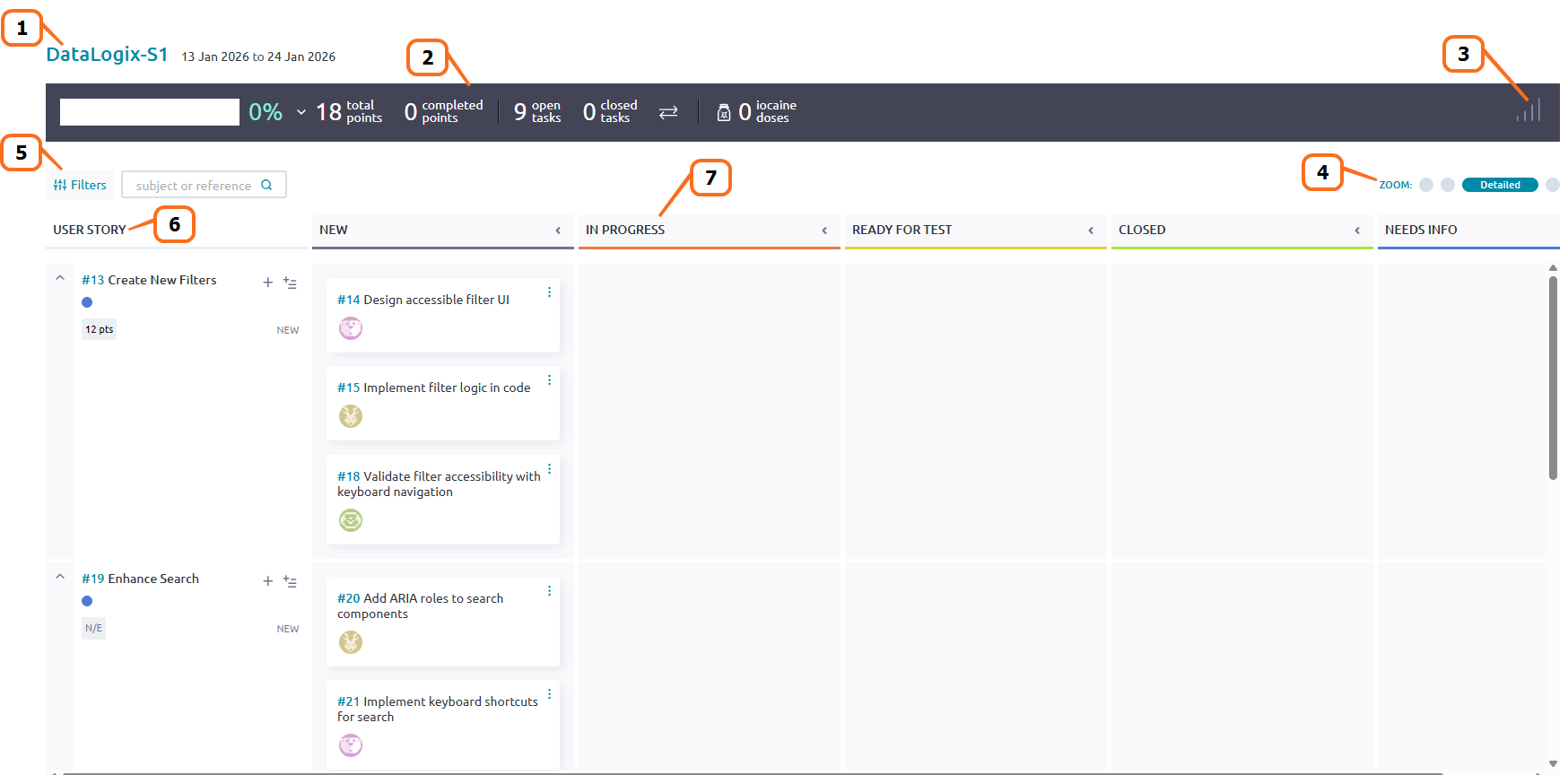
View sprint taskboard
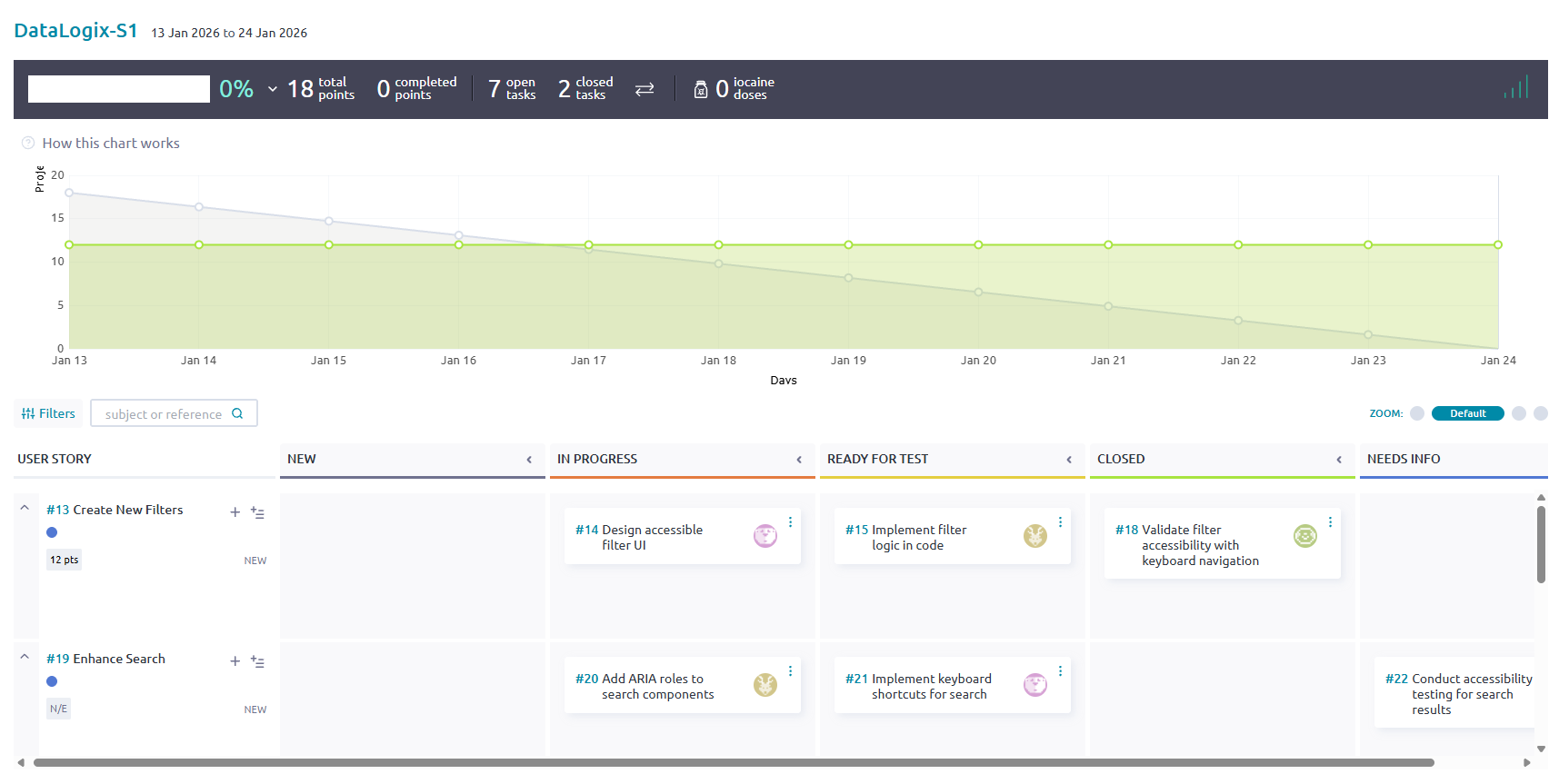
Seq. # Description 1 Sprint name and time frame. 2 Sprint status summary, including the number of total story points, completed story points, open tasks, closed tasks, and iocaine doses.
Iocaine doses are a Taiga-specific, playful gamification signal (a Princess Bride reference) that a teammate is taking on a difficult or outside-their-comfort-zone task, and may need extra support or time. See Iocaine Drinker in Manage the team board.3 Burndown chart (when selected), which shows the sprint’s approximate or projected progress based on estimated closed tasks. 4 Zoom functionality, providing expanded and compact views of the board. 5 Filter data (user stories and tasks) by keywords. 6 Assigned user stories in the sprint. 7 Status swim lanes, indicating the status of each task.
Drag and drop tasks to the relevant status lane. When all tasks are in the Closed lane, the story is closed.To display the burndown chart, select the Show statistics icon.
This chart shows your team’s progress in a sprint by displaying the remaining work against the time frame in which to complete it. The burndown chart helps identify if you’re on track (below ideal line) or falling behind (above ideal line).
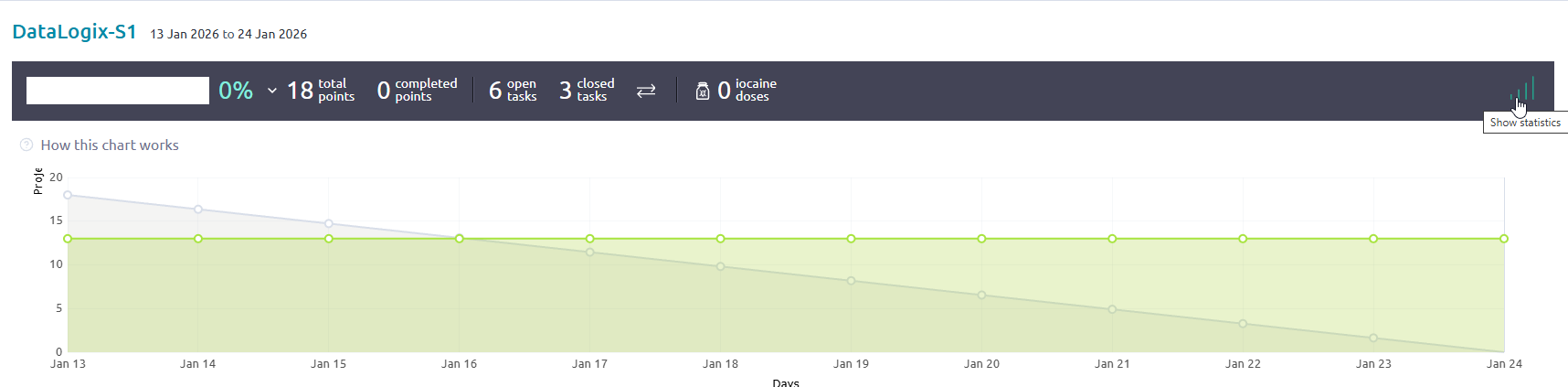
Show burn-down chart
To add additional tasks to a story, select the + icon next to the story. You can also add multiple tasks at once using the bulk task icon.
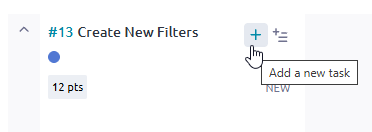
Add more story tasks
To accurately reflect any blockers and dependencies that arise, create any relevant issues:
From Sprint Issues, select the + icon.
Enter a description of the issue.
Select Add Issue.
Once an issue is created, you can track its progress, add attachments, assign to a specific member, edit, delete, or detach it from the sprint. For more information on issues, see Manage issues.

Manage issues
During the daily standups, change the status of tasks as required. At the end of a sprint, all stories should have a completed status.
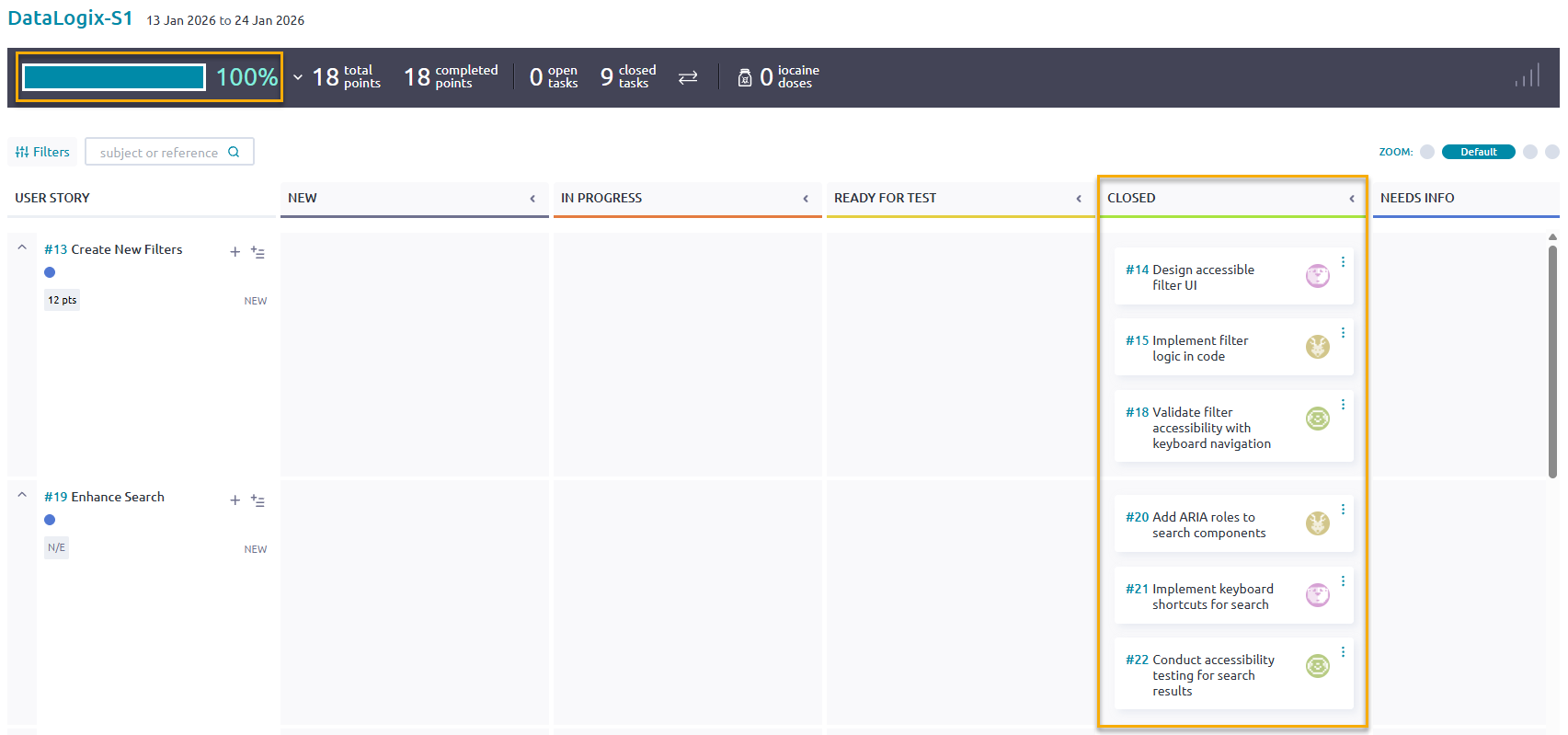
Closed issues
🌐 Project management beyond Scrum
Beyond Scrum, Taiga supports other project management methodologies. In addition to organizing work into timeboxed sprints and managing tasks and user stories, you can configure Taiga to use a Kanban board for a higher-level view of project progress. Issues may be tracked independently of sprints, and the Team Board can be utilized for any type of project to display team member roles, skills, and contributions.
Manage a Kanban board
Kanban is a high-level workflow-based Agile software development methodology for managing product development. Using Kanban, work is managed on cards, like virtual index cards or post-it notes, where each card details specific work to be completed. The Kanban board is used to track progress by moving each card from one stage to the next until completion.
Procedure
From the Taiga home page, under My projects, select the project you want.
On the project page, from the left sidebar, select Kanban.
To create a new user story for your Kanban project, from any status swim lane, select the + icon.
For example, to create a new user story called Enhance Search, select the + icon from the New swim lane.On the New user story screen, complete the fields.
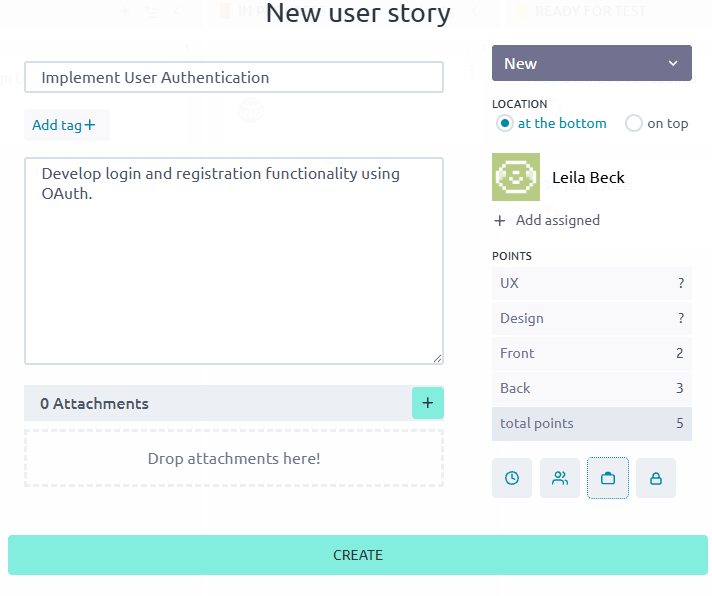
Create new user story
Field Description Subject Enter a name for the story. Description Enter the details about the story. Attachments Drop any relevant attachments (such as a feature description or development spec). Assign To assign the story to a member, select Assign, select the member you want. To assign the story to yourself, select Assign to me. Points Select the area of development you want and enter the number of story points for that area.
For example, for a UI story, enter points for UX and Design.Select Create.
The system creates the user story in the relevant status swim lane.
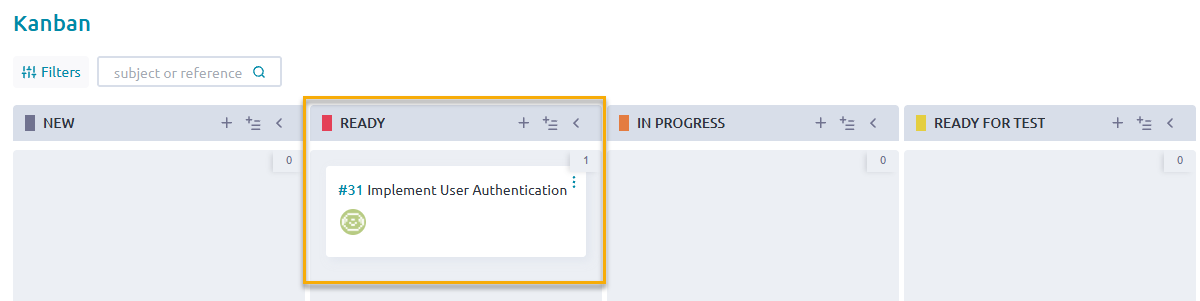
New user story created in status swim lane
To create multiple user stories in bulk:
From any status swim lane, select the Add new bulk icon.
On the New bulk insert screen, enter each story name on each line in the text box.
Select Save.
The system creates the user stories in the relevant status swim lanes.
During project status meetings, change the status of stories as required until completion.
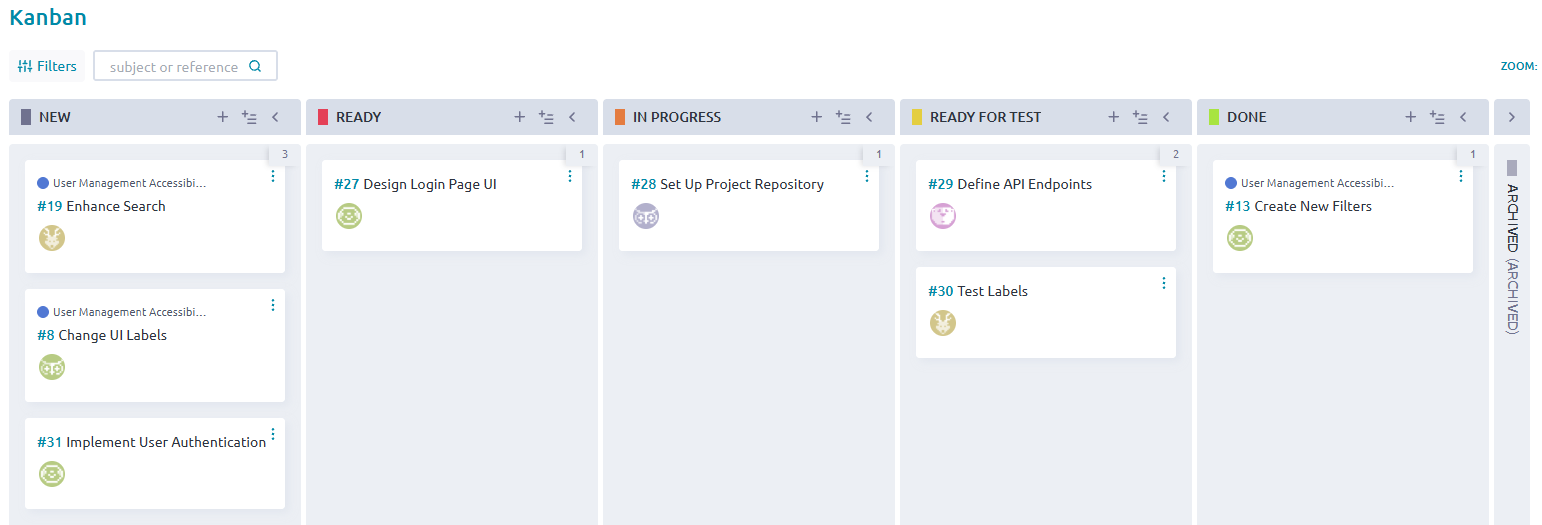
Kanban board
Manage issues
Every project encounters issues, which may include bugs, questions, dependencies, or required enhancements necessary for completion. In Taiga, issues can be managed independently of Scrum or Kanban boards, allowing you to separate core work items from blockers and ancillary tasks. This approach helps maintain focus on primary deliverables while tracking and resolving obstacles efficiently.
Procedure
From the Taiga home page, under My projects, select the project you want.
On the project page, from the left sidebar, select Issues.
To create a new issue, select + New Issue.
On the New issue screen, complete the fields.
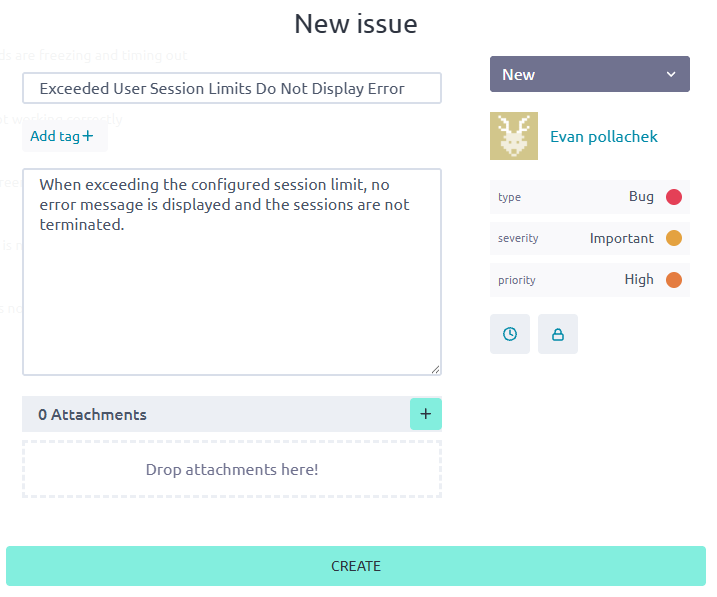
Create new issue
Field Description Subject Enter a name for the issue. Description Enter the details about the issue. Attachments Drop any relevant attachments (such as a Figma screenshot). Assign or Assign to me To assign the issue to a member, select Assign and select the member you want. To assign the issue to yourself, select Assign to me. Type Select one of the following: - Bug
- Question
- Enhancement
Severity Select one of the following: - Wishlist
- Minor
- Normal
- Important
- Critical
Priority Select one of the following: - Low
- Normal
- High
Select Create.
The new issue appears on the Issues page.
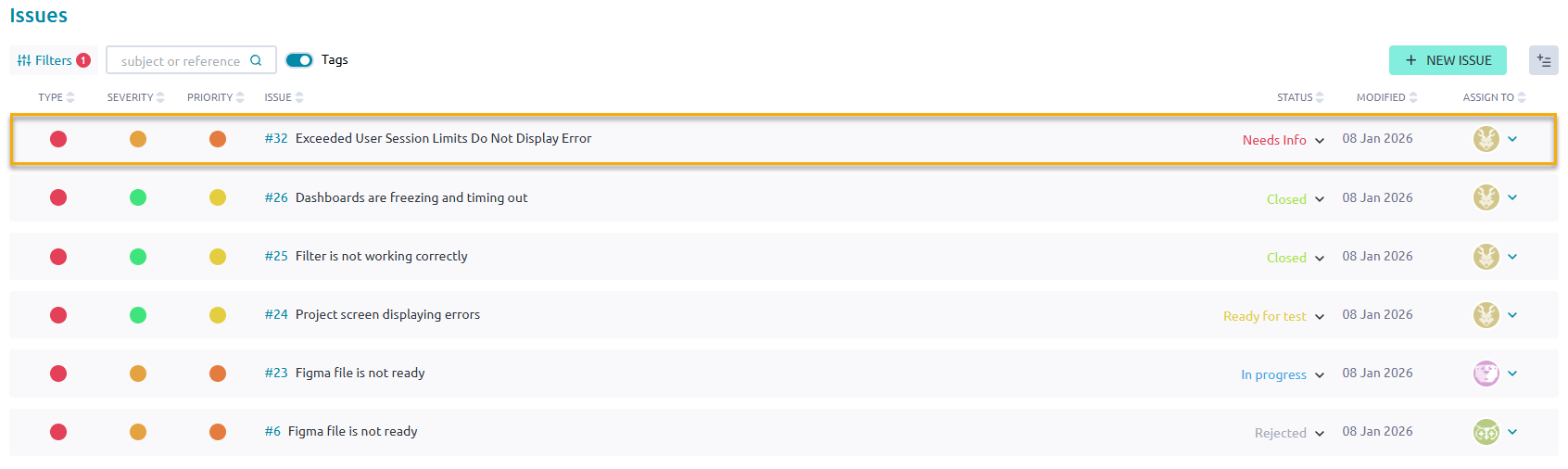
New issue
To create multiple issues in bulk:
Select the Bulk Task icon.
On the New bulk insert screen, enter each issue name on each line in the text box.
Select Save.
The system creates the issues.
To filter existing issues:
Select Filters.
Select either Include or Exclude.
For each attribute (such as Type, Severity, Priority, Status, etc.), select the values you want.
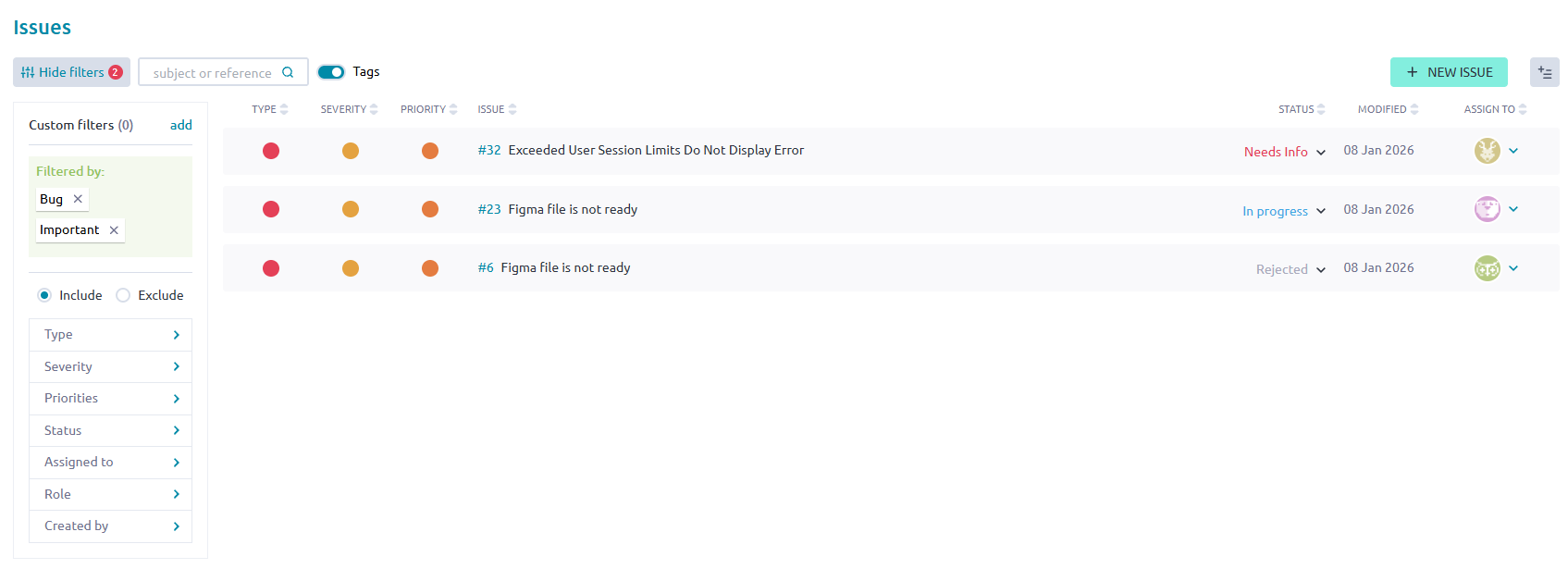
Filter issues
As needed, change the status of issues as required until completion.
Manage the team board
In Taiga, the team board can be utilized for any project type to display team member roles, skills, and contributions. It provides a centralized view of the people working on a project, including their roles, assignments, progress, strengths and skills. It helps teams align around shared objectives and manage capacity more effectively.
Procedure
From the Taiga home page, under My projects, select the project you want.
On the project page, from the left sidebar, select Team.
The system displays the team board, which lists all members in the project, their role, and their titles, which highlight their accomplishments.
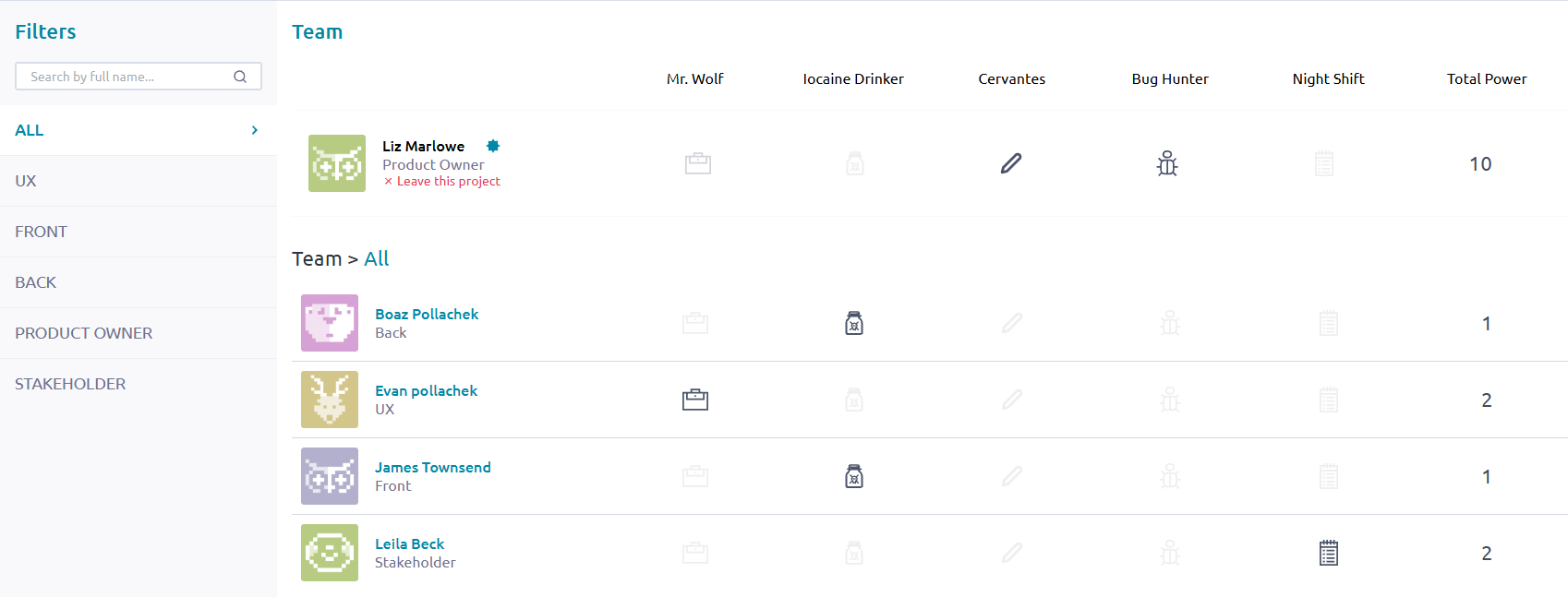
Team board
The following table describes the titles on the team board, which highlight team member skills and contributions.
Title Description Mr. Wolf Member who has closed many issues. Iocaine Drinker Member who has ingested many iocaine doses.
A fictional reference to The Princess Bride, a member who has ingested many iocaine doses in Taiga indicates that they have tackled difficult or outside-their-comfort-zone tasks. A user can mark an iocaine dose to indicate they’re tackling a difficult or outside‑their‑comfort‑zone task. (Also referenced on the Sprint Taskboard.)Cervantes Member who has edited many wiki pages. Bug Hunter Member who has reported many issues. Night Shift Member who has closed many tasks. Total Power Total number of points, or accomplishments, that the member has achieved. To filter the team members by role, from Filters, select the role you want.
For example, to view all UX team members, select UX.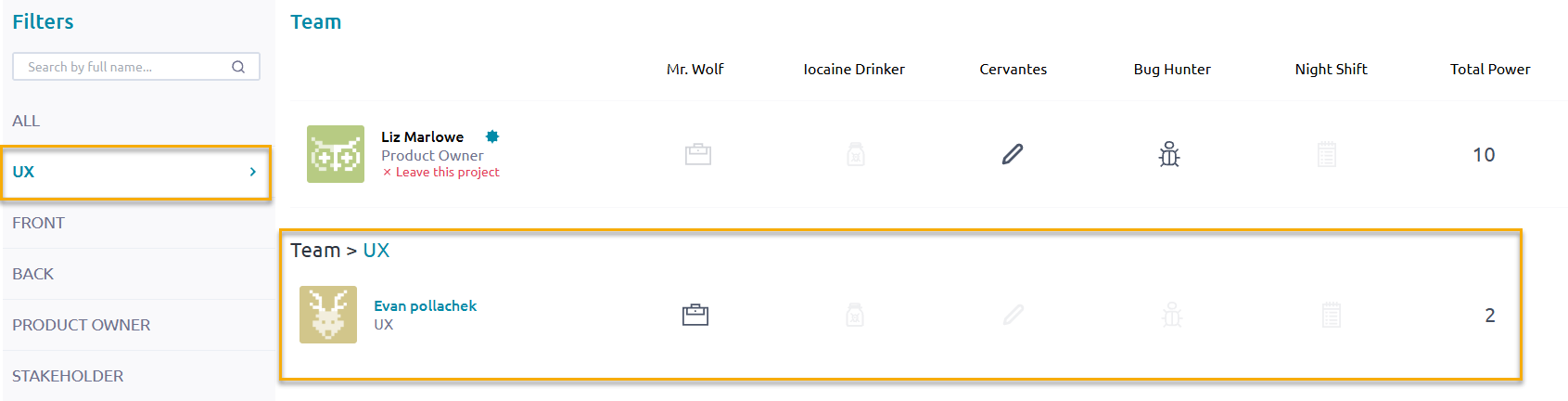
Filter team members by role
To view specific details about a team member, select the team member’s name.
The system displays details about the selected team member.
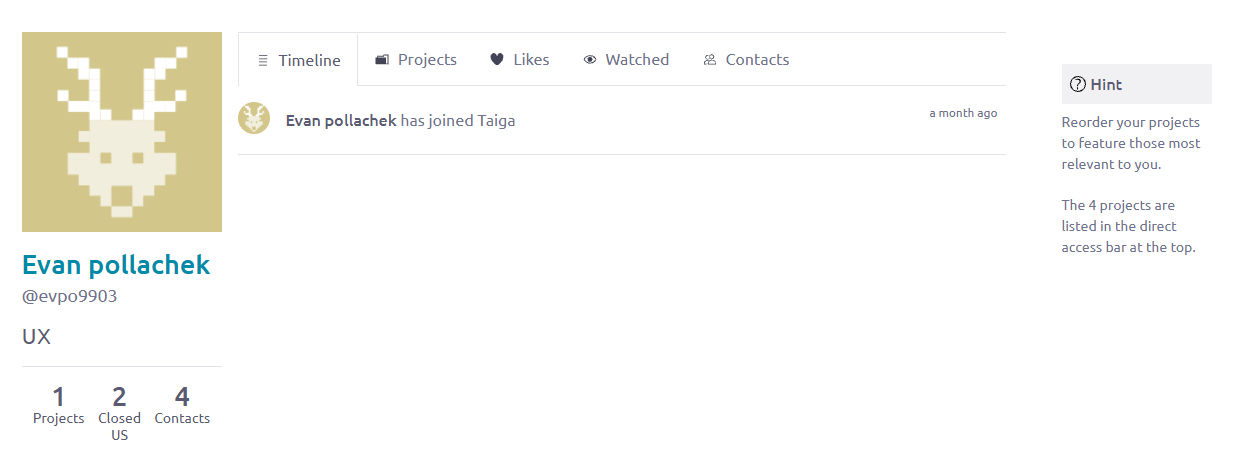
View team member details
Detail Description Projects (Number) Number of projects with which the team member is associated. Closed US Number of user stories the team member has closed. Contact Count Number of contacts for the team member. Timeline Date when the team member joined Taiga. Projects (Tab) Names of the projects with which the team member is associated. Likes Number of likes the team member has on their page. Watched Entities that the team member “watches,” including projects, epics, stories, tasks, and issues. Contact List Names of the team member’s contacts.